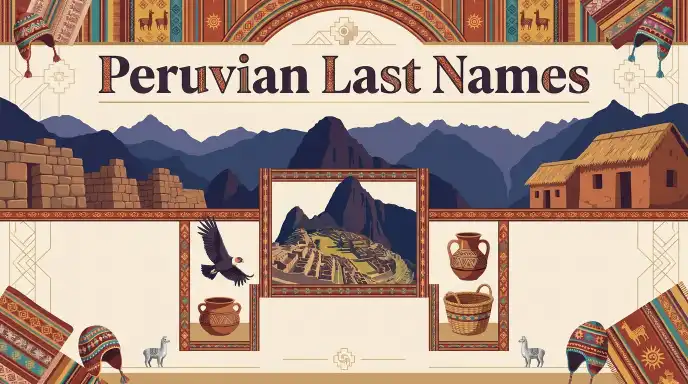
Peruvian last names reflect the country’s rich mix of Spanish, Indigenous Andean, and other cultural influences.
Common surnames include Quispe, Flores, García, Huamán, Rojas, Mamani, and Chávez. Many Peruvian family names have Spanish roots, while others come from Quechua, Aymara, and other Indigenous languages.
Their histories can offer clues about ancestry, language, and regional identity, but a surname alone cannot prove someone’s ethnic background.
Most Common Peruvian Last Names
Peru has thousands of family names. However, a smaller group appears especially often in national surname lists. These names include both Spanish-origin and Indigenous surnames.
The following examples appear among the country’s widely reported common surnames. Exact rankings can change depending on the data source and year.
| Peruvian Last Name | Commonly Associated Origin | Meaning or Background |
| Quispe | Indigenous Andean | A well-known surname associated with Quechua and Aymara-speaking communities |
| Flores | Spanish | Means “flowers” in Spanish |
| Sánchez | Spanish | Patronymic surname meaning “son of Sancho” |
| García | Spanish | An old Iberian surname with a debated etymology |
| Rodríguez | Spanish | Patronymic surname meaning “son of Rodrigo” |
| Rojas | Spanish | Related to rojo, meaning “red” |
| Huamán | Quechua-associated | Commonly associated with the Quechua word for “falcon” |
| Mamani | Aymara-associated | A prominent surname in Aymara-speaking Andean communities |
| Vásquez | Spanish | Patronymic surname linked to the name Vasco |
| Ramos | Spanish | Means “branches” or “bouquets” |
| López | Spanish | Patronymic surname meaning “son of Lope” |
| Torres | Spanish | Means “towers” |
| Pérez | Spanish | Patronymic surname meaning “son of Pedro” |
| Díaz | Spanish | Patronymic surname traditionally linked to Diego |
| Gonzales | Spanish | Variant spelling of González, linked to Gonzalo |
| Ramírez | Spanish | Patronymic surname meaning “son of Ramiro” |
| Mendoza | Basque/Spanish | A surname with geographic roots in the Iberian Peninsula |
| Chávez | Iberian | A surname with Portuguese and Spanish historical associations |
| Espinoza | Spanish | Related to espino, meaning “thorn” or “hawthorn” |
| Castillo | Spanish | Means “castle” |
Quispe, Flores, Sánchez, García, Rodríguez, Huamán, Rojas, Vásquez, Mamani, and López are among the names frequently reported in lists of Peru’s most common surnames. Rankings should always be tied to a specific dataset and year.
Indigenous Peruvian Last Names
Indigenous surnames preserve important parts of Peru’s linguistic and cultural history. Many are associated with the Andes, where Quechua and Aymara have long been spoken.
Other family names reflect Indigenous communities from the Amazon and northern coastal regions.
These surnames are not simply old names. They remain part of modern Peruvian family identity.
Quechua-Associated Peruvian Surnames
Quechua is a family of languages spoken across parts of the Andes. It has a long history in Peru and remains an important part of the country’s cultural life.
Examples of surnames associated with Quechua-speaking communities include:
- Quispe : One of the best-known Indigenous surnames in Peru.
- Huamán : Commonly connected with the Quechua word for a falcon.
- Yupanqui : A historic Andean name associated with the Inca period.
- Mayta : A surname with historical connections to the Andean region.
- Condori : A surname found in Andean communities and often associated with the condor.
- Poma : A name associated with the Quechua word for puma.
- Huanca : A name linked to the Huanca people and historical Andean identity.
- Sisa : A name found in the wider Andean naming tradition.
- Cusi : A historic Andean name associated with Inca-era records.
- Tupac : A name with strong historical associations in the Andes.
The spelling and meaning of Indigenous names can vary across languages and regions. Therefore, it is best to check a specific name against a reliable linguistic source before treating one translation as definitive.
Aymara-Associated Peruvian Surnames
Aymara is an Indigenous language spoken mainly around the Lake Titicaca region, including parts of southern Peru and neighboring Bolivia. Aymara-speaking communities have contributed greatly to the region’s history and identity.
Examples of surnames associated with Aymara-speaking communities include:
- Mamani
- Apaza
- Choque
- Condori
- Quispe
- Huarachi
- Yujra
- Callisaya
- Chura
- Ticona
Some surnames appear in both Quechua- and Aymara-speaking areas. This overlap reflects centuries of contact, migration, and shared regional history. It is not always possible to assign a surname to only one language.
Surnames from Other Indigenous Communities
Peru is home to many Indigenous peoples beyond the Quechua and Aymara communities. These include Asháninka, Shipibo-Konibo, Awajún, Wampis, Matsés, and other Amazonian and regional groups.
Their languages and naming traditions are diverse. Some family names may have roots in local languages, while others reflect colonial records, Spanish spelling, or later changes in family naming practices.
For this reason, a list of Peruvian Indigenous surnames should not treat all Indigenous names as if they came from one culture.
Spanish-Origin Peruvian Last Names
Spanish surnames became widespread in Peru during and after the colonial period. Many families still carry names that developed in Spain or other parts of the Iberian Peninsula.
Some Spanish surnames describe a person’s family connection. Others refer to places, physical features, plants, or occupations.
Spanish Patronymic Surnames
A patronymic surname comes from a father’s or ancestor’s given name. Spanish surnames often use the ending -ez, which traditionally indicates descent or family connection.
| Surname | Traditional Connection |
| Sánchez | Son of Sancho |
| Rodríguez | Son of Rodrigo |
| López | Son of Lope |
| Pérez | Son of Pedro |
| Díaz | Traditionally linked to Diego |
| González | Son of Gonzalo |
| Ramírez | Son of Ramiro |
| Fernández | Son of Fernando |
| Martínez | Son of Martín |
| Hernández | Son of Hernando or Fernando-related forms |
These patterns help explain how many Spanish family names developed. However, a modern surname does not always identify a specific ancestor or family line.
Spanish Surnames Based on Places and Features
Some surnames developed from geographic locations or descriptions of the landscape. Others came from common words used as nicknames.
Examples include:
- Mendoza : A surname with roots in the Basque region.
- Torres : Means “towers.”
- Castillo : Means “castle.”
- Vega : Refers to a fertile plain or meadow.
- Delgado : Means “slender” or “thin.”
- Moreno : Traditionally describes a dark or brown appearance.
- Rojas : Related to the Spanish word for red.
- Campos : Means “fields.”
- Rivera : Associated with a riverbank or riverside.
- Espinoza : Related to thorny plants.
These names are found across the Spanish-speaking world. Their presence in Peru reflects the country’s long history of Spanish-language naming.
Peruvian Last Names with Interesting Meanings
Some surnames have meanings that are easy to recognize because they come from familiar Spanish words. Others have linguistic or historical roots that require more careful research.
Here are examples with commonly understood meanings or associations.
| Last Name | Meaning or Association |
| Flores | Flowers |
| Rojas | Red |
| Torres | Towers |
| Castillo | Castle |
| Ramos | Branches or bouquets |
| Campos | Fields |
| Vega | Fertile plain or meadow |
| Delgado | Slender or thin |
| Espinoza | Thorny plant or hawthorn association |
| Huamán | Commonly associated with a falcon in Quechua |
| Condori | Often connected with the Andean condor |
| Poma | Associated with the puma in Quechua |
A surname’s modern meaning may differ from its original history. Some names also changed spelling as families moved or as officials recorded them in different languages.
Rare and Distinctive Peruvian Last Names
Not every Peruvian surname appears on national lists of common family names. Some are closely connected to particular regions, communities, or family histories.
The following examples offer a starting point for exploring less familiar names:
- Huarachi
- Yujra
- Callisaya
- Ticona
- Chura
- Apaza
- Neciosup
- Sarpán
- Chafloque
- Puican
- Huachuhuillca
- Olayunca
Some of these names have regional or Indigenous associations. Others are documented in northern Peruvian family histories or local naming traditions.
Rarity is difficult to establish without a complete, current population register. A surname may be uncommon nationally but familiar within one town or community.
How Peruvian Last Names Reflect the Country’s History
Peruvian surnames tell a story shaped by Indigenous societies, Spanish colonization, migration, and cultural exchange.
Before Spanish Colonization
Before the Spanish conquest, people in the region now called Peru did not generally use family surnames in the same way people do today.
Historical accounts describe naming practices that could change during a person’s life and connect individuals with family lines, ancestors, or important events.
The modern system of inherited surnames developed later. This distinction matters because today’s family names do not always match the naming customs of ancient Andean societies.
During the Colonial Period
Spanish colonial rule brought new systems of administration, baptism, and record keeping. These systems helped spread Spanish-style first names and family names.
Indigenous people could receive Spanish Christian given names while retaining or adopting names connected to their communities. Historical records show that the process was complex and varied.
As a result, modern Peru has both Spanish-origin surnames and surnames that preserve Indigenous linguistic roots.
Migration and Cultural Exchange
Peru’s surname history also reflects migration from different parts of the world. Spanish, Italian, Chinese, Japanese, German, and other communities have contributed to the country’s population and family history.
This is why a Peruvian surname does not always have Spanish or Indigenous origins. Some families carry names connected to migration and settlement during later periods.
Peruvian Two-Surname Naming Tradition
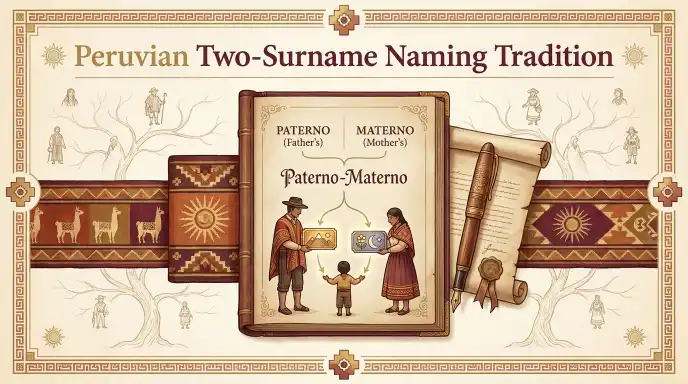
A common feature of Peruvian naming practice is the use of two family surnames. Traditionally, a person’s full name includes a first name, the father’s first surname, and the mother’s first surname.
For example:
| Name Part | Example |
| Given name | María |
| Father’s surname | Quispe |
| Mother’s surname | Flores |
| Full name | María Quispe Flores |
This format helps preserve family connections from both parents. However, legal rules and individual family circumstances can affect the order or form of surnames.
When researching Peruvian genealogy, remember to search for both surnames. Records may also show spelling variations, missing accents, or shortened forms.
How to Research Your Peruvian Family Name
A surname can offer a useful starting point for family research. However, its meaning alone cannot reveal an entire family history.
Try these steps to learn more about a Peruvian last name:
Start with Family Records
Ask relatives about older family members, birthplaces, and earlier generations. Even a small detail, such as a town or province, can help narrow your search.
Check Civil and Church Records
Birth, marriage, death, and baptism records can help connect different generations. Older church records may be especially useful when civil records are unavailable.
Look for Regional Connections
A surname may appear more often in one region than another. Check family documents for links to places such as Cusco, Puno, Ayacucho, Arequipa, Lima, or Lambayeque.
Compare Spelling Variations
Accents and spelling may change across records. For example, Huamán may appear as Huaman, while Quispe may have historical spelling variations in some documents.
Search for likely variations, but confirm that each record belongs to the correct family.
Use Reliable Sources
Government records, historical archives, academic studies, and linguistic references offer stronger evidence than unsourced surname lists.
Frequently Asked Questions
1. What are the most common Peruvian last names?
Commonly reported Peruvian surnames include Quispe, Flores, Sánchez, García, Rodríguez, Rojas, Huamán, Mamani, Vásquez, and López. Rankings can differ by source and year, so check the date and method behind any list.
2. What is the most common last name in Peru?
Quispe is frequently reported as Peru’s most common surname in published surname datasets. Recent media reports citing RENIEC data also identify Quispe as the leading surname.
Always check the year because population counts can change.
3. Are Peruvian last names Spanish or Indigenous?
Peruvian surnames can have Spanish, Quechua, Aymara, and other Indigenous roots. Some also reflect Italian, Chinese, Japanese, and other migration histories.
Peru’s family-name traditions reflect its diverse population and long history.
4. What does the Peruvian last name Quispe mean?
Quispe is a well-known surname associated with Indigenous Andean communities. It is often linked to Quechua and Aymara language traditions.
Some popular sources give symbolic interpretations, but the exact etymology should be checked against reliable linguistic research.
5. What does Huamán mean in Peru?
Huamán is commonly associated with the Quechua word for a falcon. The bird also has strong cultural associations in the Andes. The exact history of an individual family’s surname may still require genealogical research.
6. Is Mamani a Peruvian last name?
Yes. Mamani is a prominent surname in Peru, particularly in areas with Aymara-speaking communities. It is also found in neighboring Bolivia and other parts of the Andes.
7. Why do Peruvians often have two last names?
A common Peruvian naming tradition uses the father’s first surname followed by the mother’s first surname. This practice preserves family connections from both sides.
Individual records and legal circumstances may show different arrangements.
8. Do Peruvian surnames reveal Indigenous ancestry?
Some surnames have clear associations with Indigenous languages or communities. However, a surname alone cannot confirm a person’s ancestry or identity.
Family records and historical evidence provide a more reliable picture.
Conclusion:
Peruvian last names reflect a long history of Indigenous cultures, Spanish influence, and migration.
Names such as Quispe, Huamán, and Mamani preserve important Andean connections, while Flores, García, and Rodríguez show the influence of Spanish naming traditions.
To understand a particular surname, look beyond its meaning and explore family records, regional history, and language.

I’m Mia Carter, a language enthusiast and writer passionate about making grammar, words, and everyday communication simple and easy to understand. I enjoy sharing clear, practical insights that help readers communicate with confidence.