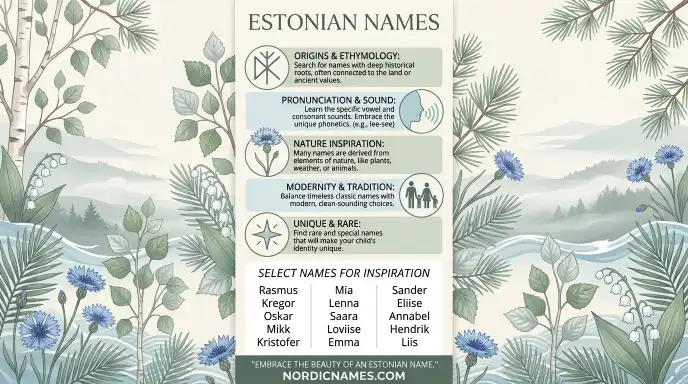
Estonian names reflect Estonia’s language, history, nature, and cultural traditions. They include native Estonian names, nature-inspired choices, traditional names, and local forms of familiar European names.
Some names have simple meanings linked to nature, such as Eha (“dusk”), Kalju (“rock”), Tuuli (“wind”), and Õie (“flower”).
If you are looking for an Estonian name for a baby, character, pet, story, or creative project, this guide brings together traditional, modern, short, distinctive, and meaningful choices.
What Are Estonian Names?
Estonian names are names used within Estonia’s naming tradition. They come from several sources, so not every name used in Estonia originally comes from the Estonian language.
Some names are closely connected to Estonian words and culture. Others are Estonian forms of older names that are also found in other European languages. This gives Estonian naming a wide range of sounds and styles.
For example, Eha means “dusk,” Kalju means “rock” or “boulder,” Tuuli means “wind,” and Õie comes from an Estonian word meaning “flower.”
This makes Estonian names especially interesting if you want a choice with a connection to nature, language, or Baltic and Nordic culture.
Beautiful Estonian Girl Names
Estonian girl names range from short and simple choices to traditional names and nature-inspired options.
| Name | Meaning or Background | Style |
| Aino | Finnish-Estonian name associated with “the only one” | Classic |
| Anu | Estonian and Finnish form related to Anna | Short |
| Eha | “Dusk” | Nature-inspired |
| Endla | Connected with an Estonian lake and folklore | Cultural |
| Helve | “Flake” or “snowflake” | Nature-inspired |
| Kaja | “Echo” | Poetic |
| Kaia | Estonian form related to Katarina | Familiar |
| Kairi | Distinctive Estonian feminine name | Modern |
| Kadri | Estonian form related to Katherine | Traditional |
| Kertu | Estonian form of Gertrude | Classic |
| Liis | Estonian short form of Eliisabet | Simple |
| Liisi | Estonian and Finnish form related to Elisabet | Soft |
| Maarja | Estonian form of Maria | Traditional |
| Maimu | Connected with the Estonian word for “little” | Unique |
| Merike | Related to Estonian meri, “sea” | Nature-inspired |
| Õie | Related to the Estonian word for “flower” | Floral |
| Piret | Estonian form of Birgitta | Traditional |
| Reet | Estonian short form related to Margareeta | Classic |
| Sirje | Distinctive Estonian name | Unusual |
| Tiiu | Established Estonian feminine name | Traditional |
| Tuuli | “Wind” | Nature-inspired |
| Ülle | Feminine form of Ülo | Distinctive |
Strong Estonian Boy Names
Estonian boy names include traditional local names and Estonian forms of names found throughout Europe.
| Name | Meaning or Background | Style |
| Aigar | Distinctive Estonian masculine name | Unusual |
| Andres | Estonian form of Andrew | Traditional |
| Andrus | Estonian form of Andrew | Classic |
| Ardo | Estonian form related to Artur | Modern |
| Arvo | “Value” or “worth” | Meaningful |
| Endel | Established Estonian masculine name | Traditional |
| Enn | Estonian short form of Hendrik | Short |
| Jaan | Estonian form of John | Classic |
| Jaanus | Related to Jaan | Traditional |
| Joonas | Estonian and Finnish form of Jonas | Familiar |
| Juhan | Estonian form of Johannes | Traditional |
| Kalev | Strongly connected with Estonian epic tradition | Cultural |
| Kalju | “Rock” or “boulder” | Strong |
| Mart | Estonian short form of Martin | Simple |
| Meelis | Established Estonian masculine name | Distinctive |
| Olev | Estonian form of Olaf | Classic |
| Tanel | Estonian form of Daniel | Familiar |
| Tarmo | Associated with vigor and energy | Strong |
| Taavi | Estonian and Finnish form of David | Classic |
| Tõnu | Short form of Tõnis | Traditional |
| Toomas | Estonian form of Thomas | Familiar |
| Toivo | “Hope” | Meaningful |
| Ülo | Established Estonian masculine name | Distinctive |
Nature-Inspired Estonian Names
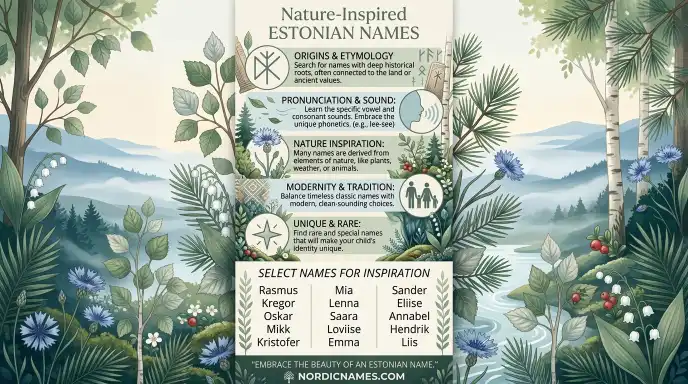
Nature is one of the most appealing themes within Estonian naming. Several names come directly from Estonian words or have strong connections with natural images.
Eha
Eha means “dusk” in Estonian. It is short, gentle, and connected with the evening sky.
Kalju
Kalju means “rock” or “boulder.” It creates an image of strength, stability, and the natural landscape.
Merike
Merike is connected with the Estonian word meri, meaning “sea.” It is a lovely option for someone looking for an ocean-inspired name.
Talvi
Talvi comes from the Estonian word talv, meaning “winter.” It has a cool and seasonal character.
Tuuli
Tuuli means “wind” in Finnish and Estonian. Its sound is soft and airy, making it a natural choice for a nature-themed name.
Õie
Õie is connected with the Estonian word õis, meaning “flower.” It has a delicate meaning and a distinctly Estonian appearance.
Pilvi
Pilvi means “cloud” in Finnish and Estonian. It has a gentle connection with the sky and works well for a dreamy nature theme.
Estonian Names With Beautiful Meanings
If you want a name chosen mainly for its meaning, these options are worth considering.
| Name | Meaning |
| Arvo | Value, worth |
| Eha | Dusk |
| Helve | Flake, snowflake |
| Kalju | Rock, boulder |
| Lembit | Love, affection |
| Luule | Poetry |
| Maimu | Little |
| Merike | Connected with “sea” |
| Õie | Flower |
| Pilvi | Cloud |
| Talvi | Winter |
| Toivo | Hope |
| Tuuli | Wind |
Meaning can add a personal layer to a name, but it is important to remember that not every Estonian name has a certain or agreed-upon etymology.
Short Estonian Names
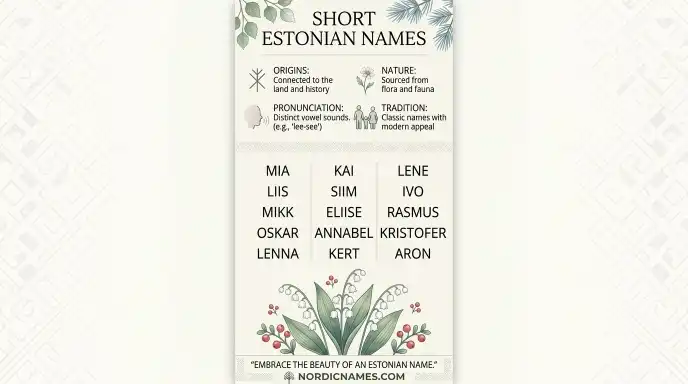
Short Estonian names are easy to remember, simple to pronounce, and often have a clean, elegant feel. They can work well for parents who prefer names that are distinctive without being complicated.
Short Girl Names
If you are looking for a short and graceful Estonian girl name, these choices offer a mix of traditional and modern styles:
- Anu
- Eha
- Ene
- Kaja
- Liis
- Maie
- Mare
- Reet
- Tiiu
- Õie
Among these, Eha stands out with its beautiful meaning, “dusk,” while Kaja means “echo.” Õie has a floral connection, making it a lovely choice for someone who enjoys nature-inspired names.
Short Boy Names
For boys, Estonian naming tradition also includes several concise names with a strong and memorable sound:
- Ain
- Enn
- Jaan
- Mart
- Olev
- Rain
- Rein
- Tiit
- Tõnu
- Ülo
Names such as Jaan, Mart, and Enn have a classic feel, while Kalju can be considered when you want a slightly longer name with the strong meaning “rock” or “boulder.”
Why Choose a Short Estonian Name?
A short name can be practical in everyday life because it is usually easy to spell, remember, and say. It can also pair nicely with a longer surname or middle name.
For a simple feminine choice, Eha, Liis, or Kaja may appeal to you. For a masculine option, Jaan, Mart, or Tõnu offers a traditional Estonian character.
Unique Estonian Names
If you want an option that feels distinctive outside Estonia, consider names such as:
- Aigar
- Endla
- Helve
- Kairi
- Kalev
- Kalju
- Leili
- Lembit
- Luule
- Maimu
- Meelis
- Merike
- Sirje
- Tarmo
- Tiiu
- Õie
Luule is especially interesting because it means “poetry.” Maimu is another distinctive choice connected with the idea of being “little.”
Traditional Estonian Names
Some Estonian names have strong cultural or historical associations.
Kalev
Kalev is closely associated with Kalevipoeg, the famous Estonian national epic. The character Kalev is the father of Kalevipoeg.
Lembit
Lembit is connected with the Estonian word lemb, meaning “love” or “affection.” It also has an important historical association with a 13th-century Estonian leader.
Endla
Endla is associated with an Estonian lake and appears in Estonian folk poetry. This gives the name both geographic and cultural connections.
Jaan
Jaan is the established Estonian form of John. It has been a familiar traditional name in Estonia for generations.
Maarja
Maarja is the Estonian form of Maria. It is one of the recognizable traditional feminine forms within Estonian naming.
Estonian Forms of International Names
Not all Estonian names developed from native Estonian words. Many familiar European names have local Estonian forms.
| International Name | Estonian Form |
| Andrew | Andres, Andrus |
| Daniel | Tanel |
| David | Taavi |
| Elizabeth | Eliisabet |
| John | Jaan |
| Johannes | Juhan |
| Joseph | Joosep |
| Martin | Märt, Mart |
| Michael | Mihkel |
| Olaf | Olev, Olavi |
| Thomas | Toomas |
| Jonas | Joonas |
| Catherine | Kadri, Katariina |
| Maria | Maarja |
| Birgitta | Piret |
This makes Estonian naming useful for people who want a culturally specific form of a name that is already familiar internationally.
Finnish and Estonian Names
Estonian and Finnish are closely related languages. Because of this relationship, some names appear in both traditions.
Examples include:
- Aino
- Arvo
- Eero
- Eeva
- Liisa
- Liisi
- Niina
- Pilvi
- Toivo
- Tuuli
- Taimi
- Tauno
A shared name should not automatically be called exclusively Estonian. Some names have stronger Finnish associations, while others are well established in both countries.
Popular Names in Estonia
Modern Estonia has a diverse naming landscape. Current name statistics include traditional Estonian names alongside names from Russian, Scandinavian, Germanic, Biblical, and other European traditions.
Among names strongly represented in Estonia in recent population statistics are male names such as Aleksandr, Sergei, Vladimir, Andrei, Martin, Andres, Toomas, Margus, Kristjan, Jüri, Jaan, Tarmo, Indrek, Sander, and Peeter.
Female names with large numbers of bearers include Olga, Irina, Jelena, Svetlana, Tatjana, Anna, Maria, Katrin, Tiina, Sirje, Anne, Ülle, Tiiu, Ene, Piret, Anneli, Riina, Kadri, Merike, Anu, and Triin.
These are names carried by people in Estonia. They should not all be described as names of Estonian linguistic origin.
Modern Estonian Baby Names
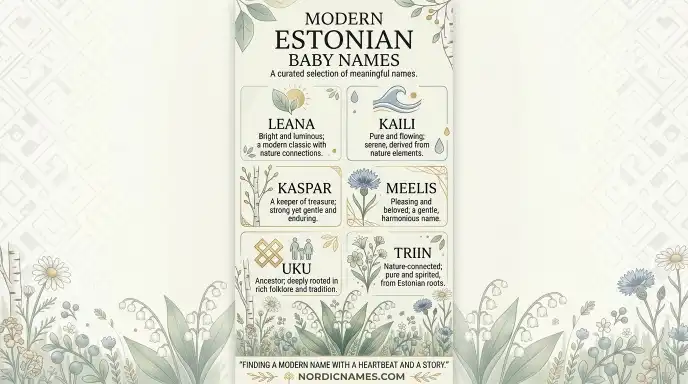
Recent naming patterns show that parents in Estonia use both local traditions and internationally familiar names.
For boys, names such as Mark, Robin, Hugo, Oliver, Sebastian, Oskar, Lukas, Aron, and David have appeared among younger generations.
For girls, recent choices include Sofia, Mia, Eva, Olivia, Emma, Emilia, Amelia, Alisa, Lenna, and Marta.
This mix shows how modern Estonian naming combines local identity with broader European naming trends.
Estonian Names for a Baby
When choosing an Estonian baby name, first decide what type of connection matters most.
For a nature-inspired name
Consider:
- Eha
- Helve
- Kalju
- Merike
- Talvi
- Tuuli
- Õie
For a traditional name
Consider:
- Jaan
- Juhan
- Kalev
- Lembit
- Maarja
- Piret
- Tiiu
For a short name
Consider:
- Anu
- Eha
- Liis
- Enn
- Jaan
- Mart
- Tõnu
- Ülo
For a meaningful name
Consider:
- Arvo : value or worth
- Eha : dusk
- Kalju : rock
- Lembit : love or affection
- Luule : poetry
- Toivo : hope
- Tuuli : wind
- Õie : flower
How Do You Choose the Right Estonian Name?

Start by deciding if you want a name that is Estonian in origin, traditionally used in Estonia, or simply inspired by Estonian culture.
Then consider these points:
- Meaning: Choose a meaning that has personal value.
- Sound: Say the full name aloud with the surname.
- Spelling: Decide if you want to keep distinctive Estonian letters.
- Pronunciation: Consider how easily people outside Estonia will say the name.
- Cultural connection: Research the name’s actual history rather than relying only on how it sounds.
- Uniqueness: A less familiar name can stand out, but make sure it still fits your purpose.
- International use: If the name will be used in several countries, check how it works in each language.
A good name does not need to satisfy every point. Focus on the qualities that matter most to you.
Estonian Surnames
Estonian naming is not limited to first names. Family names also offer an interesting connection to language and history.
Some common Estonian surnames include Tamm, Saar, Sepp, Mägi, Kask, Kukk, Ilves, Rebane, Pärn, and Koppel.
Several of these names have clear meanings in Estonian. For example, Tamm relates to “oak,” Saar means “island,” Mägi means “hill,” Kask means “birch,” and Sepp means “blacksmith.”
Estonian surnames also have an important historical background. Large-scale surname giving to peasants took place in Estonia during the 19th century, particularly between 1823 and 1835.
Common Mistakes When Choosing Estonian Names
Assuming every name used in Estonia is originally Estonian
A name may be common in Estonia without having an Estonian linguistic origin. Always distinguish between Estonian usage and Estonian origin.
Treating uncertain meanings as proven
Some name meanings are debated or unclear. If the origin is uncertain, it is better to say so than to give the name a made-up meaning.
Ignoring Estonian spelling
Letters such as õ, ä, ö, and ü are important parts of Estonian spelling. Removing them can change the appearance and sometimes the pronunciation of a name.
Choosing a name only because it sounds unusual
A distinctive sound is useful, but meaning, pronunciation, cultural background, and everyday usability also matter.
Confusing current popularity with tradition
A name can be popular among today’s children without being an old Estonian name. Current trends and historical naming traditions are different things.
Frequently Asked Questions About Estonian Names
Q1. What are some beautiful Estonian names?
Beautiful choices include Eha, Aino, Maarja, Liis, Merike, Tuuli, Õie, Kalev, Kalju, Lembit, Tarmo, and Toivo. They represent several different styles, including traditional, nature-inspired, short, and meaningful names.
Q2. What Estonian name means “dusk”?
Eha means “dusk” in Estonian. It is a short feminine name with a strong connection to the natural world.
Q3. What Estonian name means “rock”?
Kalju means “rock” or “boulder” in Estonian. It gives the name a strong and grounded natural meaning.
Q4. What Estonian name means “flower”?
Õie comes from the Estonian word õis, meaning “flower.” It is a distinctive feminine choice with a clear natural connection.
Q5. What Estonian name is connected to the sea?
Merike is connected with the Estonian word meri, meaning “sea.” It is a good option for an ocean-inspired naming theme.
Q6. What Estonian name means “hope”?
Toivo means “hope” in Finnish and Estonian. It is used in both naming traditions rather than being exclusive to Estonia.
Q7. What are some traditional Estonian boy names?
Traditional choices include Kalev, Lembit, Kalju, Jaan, Jaanus, Endel, Meelis, Tarmo, Tõnu, and Ülo.
Q8. What are some traditional Estonian girl names?
Examples include Eha, Endla, Helve, Maarja, Merike, Maimu, Õie, Sirje, Tiiu, and Liis.
Q9. Are Estonian names similar to Finnish names?
Yes. Estonian and Finnish are closely related languages, and some names are shared between the two traditions. Examples include Aino, Arvo, Eeva, Liisa, Toivo, and Tuuli.
Conclusion:
Estonian names offer a fascinating mix of native language, nature, history, folklore, and wider European influence. Choices such as Eha, Kalju, Merike, Tuuli, and Õie provide strong nature connections, while Kalev, Lembit, Jaan, Maarja, and Tiiu bring traditional and cultural character.
The most important step is to understand the difference between a name that is used in Estonia and one that is actually Estonian in origin. From there, you can choose a name based on meaning, sound, history, cultural connection, or uniqueness.

I’m Mia Carter, a language enthusiast and writer passionate about making grammar, words, and everyday communication simple and easy to understand. I enjoy sharing clear, practical insights that help readers communicate with confidence.