Funny scientific names are unusual names given to animals, plants, fungi, and other organisms. Some sound like jokes, while others contain clever wordplay or surprising references. As a result, they make science more entertaining and memorable.
For example, Agra cadabra sounds like a magical phrase, while Spongiforma squarepantsii references a famous cartoon character. In addition, many animals have funny common names that make people curious about biology.
This guide explores real scientific names, amusing animal names, and creative ideas for science projects. You will also find funny names for trivia teams and usernames. However, it is important to distinguish genuine scientific names from common names and invented jokes.
What Makes Scientific Names Funny?
A scientific name may sound funny because of its pronunciation, spelling, or unexpected meaning. Sometimes, a name resembles a familiar phrase. In other cases, it includes a playful reference to popular culture.
Here are some common reasons these names stand out:
- Wordplay: A scientific name may resemble a joke or familiar expression.
- Unusual pronunciation: Some names are simply fun to say aloud.
- Unexpected references: Certain names honor people or reference popular culture.
- Strange combinations: Long or unusual words can sound amusing together.
- Funny common names: Everyday labels for organisms can be just as entertaining.
For example, Agra cadabra resembles the word “abracadabra.” Similarly, Spongiforma squarepantsii contains a recognizable pop culture reference.
However, not every unusual name has a humorous origin. Some names describe an organism’s features, habitat, or other characteristics. Therefore, the humor often comes from how the name sounds to modern readers.
Funny Scientific Names of Real Organisms
Several organisms have scientific names that sound playful or surprising. Some contain wordplay, while others stand out because of their length or unusual spelling.
Here are four memorable examples:
| Scientific Name | Organism | Why It Is Funny |
| Agra cadabra | Ground beetle | Its name resembles the magical phrase “abracadabra.” |
| Ba humbugi | Land snail | Its name resembles the expression “Bah, humbug!” |
| Spongiforma squarepantsii | Fungus | Its species name references SpongeBob SquarePants. |
| Parastratiosphecomyia stratiosphecomyioides | Soldier fly | Its extremely long name is difficult to pronounce. |
For example, Agra cadabra uses playful word construction. Meanwhile, Spongiforma squarepantsii stands out because of its cultural reference.
These examples show how scientific names can be memorable for different reasons. Nevertheless, taxonomic names and classifications may change over time. Therefore, verify the spelling and current status before using a name in formal research.
Funny Animal Names That Sound Like Jokes
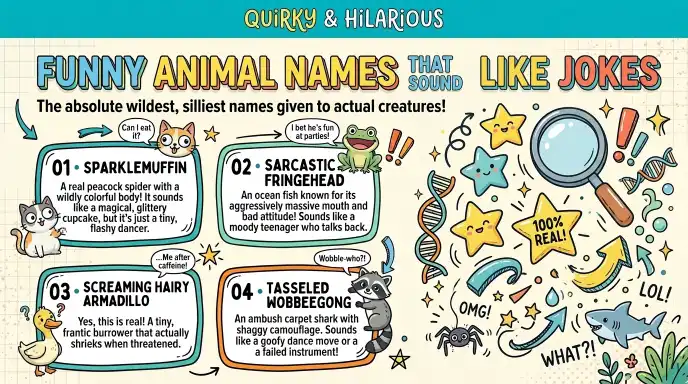
Some animals have common names that sound hilarious, even when their scientific names are ordinary. In fact, these names are popular choices for science trivia and educational activities.
| Animal | Scientific Name | What Makes It Memorable |
| Blue-footed booby | Sula nebouxii | The word “booby” gives its common name a funny sound. |
| Blobfish | Psychrolutes marcidus | Its common name is short and playful. |
| Aye-aye | Daubentonia madagascariensis | Its repeated name is unusual and memorable. |
| Red-lipped batfish | Ogcocephalus darwini | Its bright lips give it a striking appearance. |
| Naked mole-rat | Heterocephalus glaber | Its common name combines several unexpected words. |
Example: “Blobfish” is the common name, while Psychrolutes marcidus is its scientific name.
This distinction is important when creating educational content. Otherwise, readers may confuse everyday animal names with formal scientific labels.
Moreover, funny common names can make science easier to remember. They also give teachers a simple way to introduce students to animal classification.
Funny Scientific Names of Insects
Insects have many unusual names. Some sound dramatic, while others are entertaining because of their pronunciation or word combinations.
The following examples include common names and scientific group names.
| Insect or Group | Name | Interesting Detail |
| Tsetse fly | Glossina species | “Tsetse” has a distinctive sound. |
| Assassin bugs | Reduviidae | Their common name sounds like a fictional villain. |
| Dobsonflies | Corydalidae | Their common name is short but unusual. |
| Scorpionflies | Mecoptera | The name combines references to two different animals. |
For example, “assassin bug” sounds dramatic because it uses a word associated with fictional villains. Similarly, “scorpionfly” combines two familiar animal names.
However, these examples do not all represent individual scientific species names. Some identify larger groups or genera.
Therefore, if you are preparing a school assignment, choose a particular insect species and confirm its complete scientific name. You can still include funny common names to make your project more engaging.
Funny Scientific Names of Plants and Flowers

Plants also have names that sound strange, dramatic, or amusing. Some common names describe their appearance, while others refer to their smell or unusual features.
| Plant | Scientific Name | Why It Stands Out |
| Venus flytrap | Dionaea muscipula | Its scientific name sounds unusual and dramatic. |
| Monkey puzzle tree | Araucaria araucana | Its common name sounds like a puzzle or challenge. |
| Skunk cabbage | Symplocarpus foetidus | Its common name refers to its strong odor. |
| Corpse flower | Amorphophallus titanum | Its dramatic common name relates to its odor. |
Example: The name “monkey puzzle tree” sounds like a challenge from a game. In contrast, “corpse flower” describes a plant known for its strong odor.
These examples show how nature inspires memorable names. However, the humorous part often comes from the common name rather than the formal scientific name.
In addition, some plants can be toxic. Therefore, never eat or handle an unfamiliar plant based only on its name or appearance.
Funny Scientific Names of Fungi
Fungi have some of the most unusual common names in nature. Their shapes, colors, and odors often inspire labels that sound spooky or funny.
Here are a few memorable examples:
| Fungus | Scientific Name | What Makes It Interesting |
| Dead man’s fingers | Xylaria polymorpha | Its shape resembles fingers. |
| Bleeding tooth fungus | Hydnellum peckii | Its appearance can resemble droplets of red liquid. |
| Chicken of the woods | Laetiporus species | Its common name compares the fungus to chicken meat. |
| Shaggy inkcap | Coprinus comatus | Its common name refers to its appearance and ink-like liquid. |
For example, “dead man’s fingers” sounds spooky because of the fungus’s shape. Meanwhile, “chicken of the woods” has a playful name that compares the fungus to food.
However, these are mainly examples of unusual common names. They should not all be described as funny scientific names.
Safety tip: Never eat a wild mushroom based on its name or photograph alone. Instead, rely on qualified identification because some fungi are dangerous.
Funny Scientific Names Inspired by Pop Culture
Some scientific names contain references to familiar characters or expressions. As a result, they can be especially entertaining for readers who enjoy both science and pop culture.
One example is Spongiforma squarepantsii, a fungus whose species name references SpongeBob SquarePants. Another is Agra cadabra, a ground beetle name that resembles “abracadabra.”
These examples demonstrate how scientific naming can include wordplay and cultural references. In addition, they show that scientific labels do not always have to sound serious.
However, not every unusual name has a humorous story behind it. Therefore, check the naming explanation before claiming a connection to a celebrity, character, or joke.
For a quiz or article, include a short explanation beside each name. That way, readers can understand the reference and remember the example more easily.
Funny Names for Science Projects

A science project can have a playful title without using an actual scientific species name. These original ideas work well for school experiments, presentations, and classroom activities.
| Project Name | Best For |
| The Great Germ Escape | Microbiology-themed projects |
| The Periodic Table of Chaos | Chemistry |
| Operation: Lab Coat | General science |
| The Curious Case of the Missing Molecule | Chemistry |
| The Experiment That Escaped | Creative experiments |
| The Mystery of the Melting Matter | Matter and temperature |
| The Hypothesis Heroes | Group projects |
| Mission Possible: Science Edition | Science presentations |
| The Atomic Jokers | Chemistry activities |
| The Mad Scientist Society | Science clubs |
Example: “The Periodic Table of Chaos” suits a playful chemistry presentation. Meanwhile, “The Mystery of the Melting Matter” works well for an experiment about temperature and changes in matter.
Choose a title that matches your project. For a formal presentation, you can pair a funny title with a clear scientific description.
Remember, these are invented project names rather than official scientific names. Therefore, label them as creative titles when necessary.
Funny Scientific Names for Trivia Teams
A science trivia team needs a name that is easy to remember and fun to say. Science words mixed with humor can make an excellent team name.
Here are some creative options:
- The Lab Rats
- Ctrl Alt Defeat
- The Mad Molecules
- The Hypothesis Hooligans
- The Quantum Quackers
- The Noble Gas Gang
- The Unstable Elements
- The Brainy Bunsen Burners
- The Proton Posse
- The Microscopic Misfits
- The Curious Catalysts
- The Genome Comedians
For a chemistry team, The Noble Gas Gang or The Unstable Elements are clever choices.
If your team enjoys general science, try The Lab Rats or The Hypothesis Hooligans.
For a playful competition, Ctrl Alt Defeat or The Quantum Quackers can add a fun twist.
Each option offers a different style. For example, The Unstable Elements suits a team that enjoys chemistry jokes. Meanwhile, Ctrl Alt Defeat adds a computer-inspired twist to the humor.
Before using a name for a public event, check if another team already uses it.
Funny Scientific Names for Usernames

Science-inspired usernames can be clever without being difficult to spell. Short combinations often work well for gaming accounts, social profiles, and online communities.
Consider these ideas:
- NerdyNeuron
- CosmicCactus
- LaughingLabRat
- QuantumQuokka
- TinyTelescope
- AtomicAvocado
- CuriousChromosome
- BrainyBacteria
- TheoreticalBanana
- WittyElectron
- SleepyScientist
- ProfessorPickle
- MolecularMischief
- ChaoticChemist
- CosmicBeaker
A good username should be easy to read and remember. For example, AtomicAvocado mixes scientific language with a familiar food. Meanwhile, ProfessorPickle sounds playful and suits a lighthearted science account.
You can also combine a favorite subject with an everyday object. As a result, the name may feel more original and personal.
Before choosing one, check availability on your preferred platform. If the name is taken, try adding a short word related to your interests.
How to Choose the Best Funny Scientific Name
The best choice depends on your purpose. A real scientific name suits educational content, while an invented name may work better for a team or project.
Use these tips to make your choice:
- Decide on the purpose: Choose a real species name for science facts or an original phrase for a team.
- Check the spelling: Scientific names often contain unfamiliar words and letter combinations.
- Keep it memorable: A name with a clear joke or unusual sound can be easier to remember.
- Know your audience: A silly title may suit a classroom activity but not a formal research paper.
- Explain the meaning: A short explanation helps readers understand why a name is funny.
- Check the facts: Confirm the organism and classification before presenting a name as scientific.
- Avoid false claims: Never invent an origin story and present it as fact.
For example, a trivia team can use a playful name without explaining its scientific background. However, an educational article needs accurate details and clear definitions.
Ultimately, the best name balances humor, clarity, and purpose. A little research can make your choice more interesting and trustworthy.
Common Mistakes When Using Funny Scientific Names
Funny names can make science more enjoyable. However, careless use can create confusion, especially in educational content.
Avoid these common mistakes:
- Mixing up common and scientific names: “Blue-footed booby” is a common name, while Sula nebouxii is its scientific name.
- Using incorrect spelling: Double-check unusual names before publishing them.
- Inventing meanings: Do not claim a name has a particular origin without reliable evidence.
- Ignoring classification changes: Older sources may use names that are no longer accepted.
- Calling every funny name scientific: A common animal name is not automatically a scientific name.
- Leaving out context: A brief explanation helps readers understand the humor.
For example, calling “blobfish” a scientific name would be inaccurate because it is a common name. Instead, provide the accepted scientific name when you need formal identification.
In addition, check unfamiliar names against reliable taxonomic references. This simple step helps keep your article both entertaining and accurate.
Frequently Asked Questions
Q1. What are funny scientific names?
Funny scientific names are formal organism names that sound amusing, contain wordplay, or include surprising references. For example, Agra cadabra and Spongiforma squarepantsii stand out because of their unusual wording or cultural references.
Q2. What is an example of a funny scientific name?
One example is Spongiforma squarepantsii, a fungus whose species name references SpongeBob SquarePants. Another is Agra cadabra, a ground beetle name that resembles the magical phrase “abracadabra.”
Q3. Are funny scientific names real?
Yes, some genuine scientific names contain wordplay or unusual references. However, many funny labels are common names rather than formal scientific names. Therefore, check the full name and classification when accuracy matters.
Q4. Why do scientists give organisms unusual names?
Scientists may name organisms after their features, habitats, locations, or people. In some cases, names also include wordplay or cultural references. However, scientific naming follows established conventions rather than requiring every name to sound serious.
Q5. What is a funny name for a science project?
The Periodic Table of Chaos, The Great Germ Escape, and The Hypothesis Heroes are playful project names. For example, the first suits a chemistry presentation, while the second works for a microbiology-themed activity. These are creative titles, not official scientific names.
Q6. What are some funny science trivia team names?
The Lab Rats, The Unstable Elements, and The Quantum Quackers are fun options. For chemistry teams, The Noble Gas Gang is another clever choice. Meanwhile, general science groups may enjoy The Hypothesis Hooligans.
Q7. Are funny animal names the same as scientific names?
No. Common names are used in everyday speech, while scientific names provide formal labels for organisms. For example, “blue-footed booby” is a common name, whereas Sula nebouxii is its scientific name.
Q8. Can I create my own scientific-sounding name?
Yes. You can invent names for fictional creatures, games, projects, or usernames. However, label them as fictional or creative names rather than presenting them as accepted scientific names for real organisms.
Conclusion:
Funny scientific names reveal an entertaining side of biology. Names such as Agra cadabra and Spongiforma squarepantsii show how wordplay and cultural references can make scientific labels memorable.
For science projects, trivia teams, and usernames, creative names offer even more options. However, always distinguish genuine scientific names from common names and invented ideas. That way, your collection can entertain readers while keeping the information accurate.

I’m Mia Carter, a language enthusiast and writer passionate about making grammar, words, and everyday communication simple and easy to understand. I enjoy sharing clear, practical insights that help readers communicate with confidence.