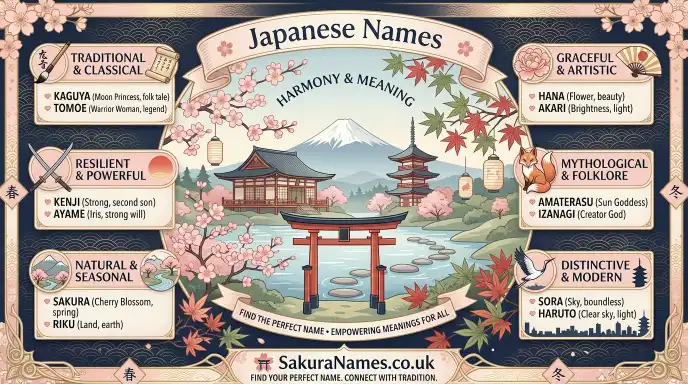
Japanese names offer a beautiful mix of tradition, nature, elegance, and modern style. Many names have meaningful connections to flowers, seasons, light, strength, or other cultural ideas.
Their meanings can also change depending on the kanji characters used to write them. This guide explores beautiful Japanese names for different styles and purposes, including traditional, modern, cute, short, nature-inspired, and gender-neutral options.
You’ll also find practical tips for understanding kanji, pronunciation, cultural context, and choosing a name that feels natural and meaningful.
What Makes Japanese Names Special?
Japanese names often combine a given name with a family name. In Japanese usage, the family name traditionally comes before the given name. This order is also used in many official and cultural contexts.
The written form matters, too. A name may have several possible readings or spellings, so its sound alone does not always tell you its full meaning.
Japanese names can feel:
- Elegant and gentle
- Short and simple
- Nature-inspired
- Traditional
- Modern
- Strong and distinctive
- Poetic and symbolic
For this reason, Japanese names offer many styles for babies, characters, pets, usernames, and creative projects.
Beautiful Japanese Girl Names
Japanese girl names often have soft sounds and graceful imagery. Nature, seasons, flowers, light, and beauty are common themes in name choices.
| Name | Common Meaning or Association |
| Aiko | Often associated with love and affection |
| Hana | Flower |
| Hikari | Light |
| Kaori | Fragrance or pleasant scent |
| Sakura | Cherry blossom |
| Yuki | Can have meanings such as snow or happiness, depending on the characters |
| Emi | Often associated with beauty or blessing, depending on the kanji |
| Akari | Light or brightness |
| Haruka | Can have several meanings depending on the kanji |
| Naomi | A name with several possible kanji combinations |
Sakura is especially recognizable because cherry blossoms are strongly associated with Japanese culture. Hikari also creates a bright and uplifting impression through its association with light.
Beautiful Japanese Boy Names
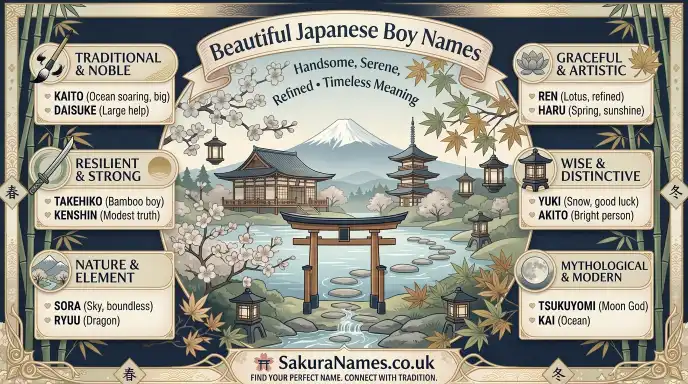
Japanese boy names can range from gentle and nature-inspired to bold and traditional. The exact meaning often depends on the kanji selected.
| Name | Common Meaning or Association |
| Haruto | Can have several meanings depending on the kanji |
| Ren | Often associated with lotus when written with 蓮 |
| Sora | Sky |
| Kaito | Can have different meanings depending on the kanji |
| Riku | Land or shore in some kanji forms |
| Hiroto | Several possible meanings based on the kanji |
| Daiki | Can express ideas such as great brightness or strength |
| Itsuki | Can have several kanji interpretations |
| Takumi | Artisan, craftsman, or skillful person in one common form |
| Yuto | Several possible meanings depending on the characters |
Ren and Sora are especially appealing if you want a short name with a strong natural image.
Cute Japanese Names
Short names often work well when you want something cute, simple, and easy to remember.
Some ideas include:
- Momo
- Hana
- Yuki
- Sora
- Nana
- Rin
- Mio
- Aoi
- Koko
- Niko
These names can also work well for pets, fictional characters, and usernames. However, if you are choosing a name for a real person, check the intended Japanese spelling and meaning rather than relying only on the romanized form.
Japanese Names Inspired by Nature
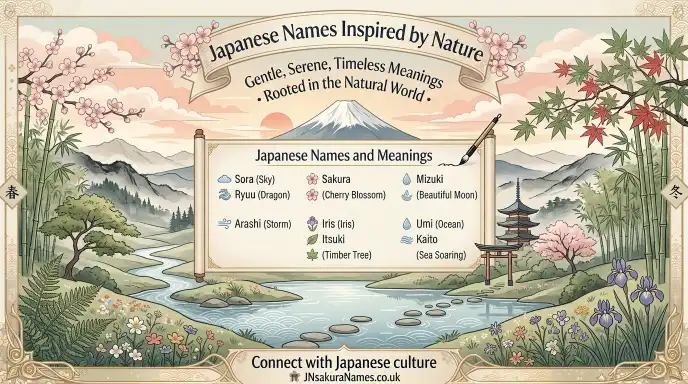
Nature is a rich source of Japanese naming imagery. Flowers, seasons, sky, water, trees, and natural beauty can all appear in names.
Flower-Inspired Names
- Sakura : cherry blossom
- Hana : flower
- Sumire : violet
- Ayame : iris
- Kaede : maple
Sky and Weather Names
- Sora : sky
- Hikari : light
- Ame : rain as a Japanese word
- Kaze : wind as a Japanese word
- Hoshi : star as a Japanese word
Plant and Tree Names
- Kaede : maple
- Maki : can have associations with trees or plants depending on the kanji
- Itsuki : can be written with characters connected to trees
Not every Japanese natural word is automatically used as a conventional given name. Kanji choice and actual naming usage matter, so creative names should be treated differently from established personal names.
Traditional Japanese Names
Traditional Japanese names can have a timeless quality. Some remain familiar today, while others are more strongly associated with earlier generations.
Examples include:
- Chiyo
- Fumiko
- Keiko
- Sachiko
- Yoshiko
- Toshiko
- Kazuo
- Masao
- Takeshi
- Hiroshi
Traditional names can be especially useful for historical characters, family-inspired naming, and stories set in earlier periods.
However, a name’s popularity and social impression can change over time. A name that feels traditional today may have been very ordinary or fashionable in another generation.
Modern Japanese Names
Modern Japanese names often favor names that are easy to say, visually appealing, or connected with positive imagery.
Some contemporary-style ideas include:
- Haru
- Rin
- Ren
- Aoi
- Sora
- Yuna
- Mio
- Mei
- Koharu
- Haruto
Modern does not always mean newly invented. Many modern names use older Japanese vocabulary or kanji in newer combinations.
Gender-Neutral Japanese Names
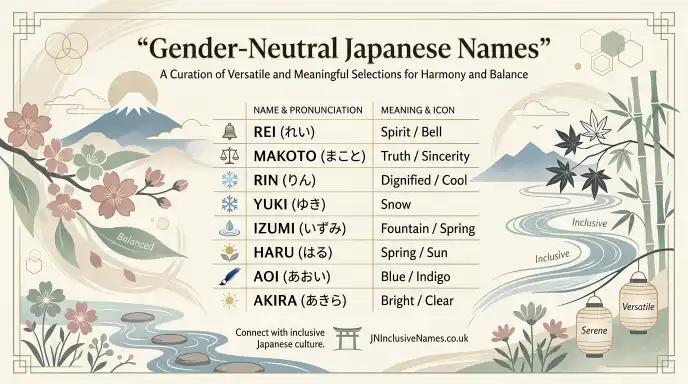
Some Japanese names can work across genders, especially when their meaning or sound is not strongly gendered.
Examples include:
- Aoi
- Haru
- Ren
- Sora
- Yuki
- Hinata
- Kaoru
- Makoto
- Akira
The same romanized name may have different kanji and meanings. Therefore, gender usage can depend on the specific written form and naming context.
Japanese Names With Beautiful Meanings
One important feature of Japanese naming is that the same pronunciation can have different meanings when different kanji are used.
For example, Yuki may represent different meanings depending on the characters chosen. Likewise, names such as Haru, Aoi, Ren, and Akira can have more than one possible written form.
This means you should not treat a romanized name as having only one fixed definition.
When choosing a Japanese name for its meaning, consider three things:
- Pronunciation
- Kanji
- Meaning of the chosen characters
The combination gives the name its intended identity.
How Do Japanese Names Work?
Japanese names commonly consist of a family name followed by a given name in Japanese order. Government and cultural materials also use this order in Japanese contexts.
For example:
Family Name + Given Name
A fictional example would be:
Tanaka Haru
Here, Tanaka is the family name and Haru is the given name.
In English-language contexts, names may instead appear in the Western order. This is why you may see the same person written with the given name first in international materials.
Why Does Kanji Matter in Japanese Names?
Kanji can add meaning and nuance to a Japanese name. Two names that sound identical when written in English letters may have different meanings when written with different Japanese characters.
For example, a romanized name such as Haru does not tell you which kanji has been selected.
This is important when you want a name for:
- A real baby
- A character
- A novel
- A game
- A pet
- A creative project
For fictional naming, you have more freedom. For a real Japanese name, however, natural usage and appropriate kanji selection deserve more attention.
Short Japanese Names
Short names are easy to remember and can have a clean, modern feel.
Some possibilities include:
| Name | Style |
| Ren | Simple and elegant |
| Rin | Short and refined |
| Mei | Soft and modern |
| Mio | Gentle and bright |
| Aoi | Nature-inspired |
| Haru | Warm and simple |
| Yuki | Familiar and versatile |
| Sora | Natural and airy |
| Riku | Strong and concise |
| Rei | Minimal and elegant |
Short names are also useful for fictional characters and pets because they are easy to pronounce and remember.
Japanese Names for Fictional Characters
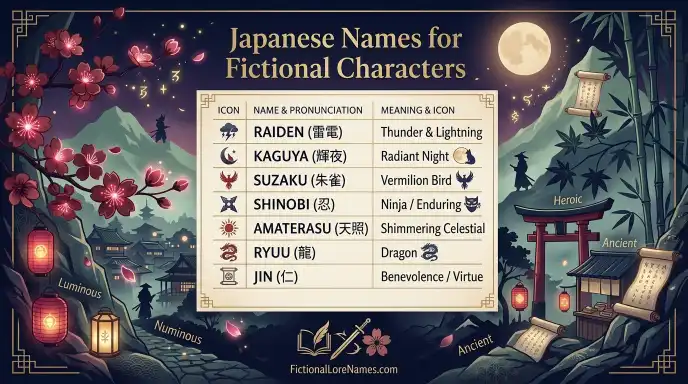
Japanese names can work beautifully for anime-inspired characters, novels, games, and other creative projects. The best choice depends on the character rather than simply choosing a name that sounds Japanese.
Consider the character’s:
- Age
- Personality
- Setting
- Family background
- Historical period
- Gender
- Social environment
- Role in the story
For a gentle character, a soft-sounding name such as Hana or Mio may fit the intended style. A strong character might suit a name such as Takeshi or Riku.
For historical fiction, research the period before selecting a modern-sounding name.
How to Choose the Right Japanese Name
Start with the purpose of the name. A name for a baby should be approached differently from a name for a fictional character or pet.
Then consider these points:
- Choose the sound you like.
Say the name aloud several times. - Check the written form.
Do not rely only on English spelling. - Understand the intended meaning.
Different kanji can change the meaning. - Consider cultural context.
A name may sound natural in one setting but unusual in another. - Check pronunciation.
Make sure other people can say it comfortably if that matters. - Think about the full name.
A given name should work naturally with the family name. - Avoid choosing kanji only for appearance.
The characters should match the intended reading and meaning.
Common Mistakes When Choosing Japanese Names
A beautiful romanized spelling does not always make a name culturally accurate.
Avoid these common mistakes:
- Assuming one spelling has one fixed meaning
- Choosing kanji without checking the intended reading
- Treating every Japanese word as a personal name
- Using a historical name without considering its period
- Assuming a name’s gender from its English spelling
- Selecting a name only because it sounds anime-inspired
- Ignoring the difference between family names and given names
- Translating a name too literally
The biggest issue is often confusing a Japanese word with a naturally used Japanese personal name.
Japanese Names vs. Japanese Words
Not every beautiful Japanese word is a common personal name.
Words such as Hoshi meaning “star” or Kaze meaning “wind” can sound attractive in creative naming. However, that does not automatically mean they are standard given names.
This distinction matters most when naming a real person.
For fiction, gaming, pets, or creative projects, you can take more artistic freedom. For an actual personal name, check if the proposed name and kanji are genuinely used in Japanese naming.
Frequently Asked Questions
Q1. What are some beautiful Japanese names?
Beautiful options include Sakura, Hana, Hikari, Aoi, Yuki, Ren, Sora, Haru, Mio, and Akira. The best choice depends on the desired sound, meaning, gender usage, and kanji.
Q2. Do Japanese names have meanings?
Yes. Many Japanese given names have meanings connected to the kanji characters used to write them. A single pronunciation can have several possible written forms, so the meaning may change with the kanji.
Q3. Are Japanese names written with kanji?
Many Japanese personal names are written with kanji, although hiragana and other writing forms can also appear. The appropriate written form depends on the individual name and context.
Q4. What are some gender-neutral Japanese names?
Aoi, Haru, Ren, Sora, Yuki, Hinata, Kaoru, Makoto, and Akira can be used across genders, although usage can vary by name and written form.
Q5. What are some short Japanese names?
Popular short-style choices include Ren, Rin, Mei, Mio, Aoi, Haru, Rei, and Sora. Short names can feel especially clean and modern.
Q6. Can I use a Japanese word as a name?
You can use Japanese words creatively for characters, pets, or projects. However, a Japanese word is not automatically a conventional personal name. Real-world naming usage and kanji should be checked before choosing one for a person.
Q7. Why can one Japanese name have different meanings?
Japanese names can use different kanji characters while keeping the same pronunciation. Since each character can carry its own meaning, the written form can change the name’s interpretation.
Q8. Should I choose a Japanese name based only on its English spelling?
It is better to consider the Japanese pronunciation, kanji, meaning, and cultural usage together. Romanization alone can hide important differences between names.
Conclusion:
Japanese names offer a wide range of sounds, meanings, and styles. You can find choices that feel traditional, modern, elegant, cute, strong, or nature-inspired.
The most important step is to look beyond the English spelling. Check the pronunciation, kanji, meaning, and real-world usage before making your final choice.

I’m Mia Carter, a language enthusiast and writer passionate about making grammar, words, and everyday communication simple and easy to understand. I enjoy sharing clear, practical insights that help readers communicate with confidence.