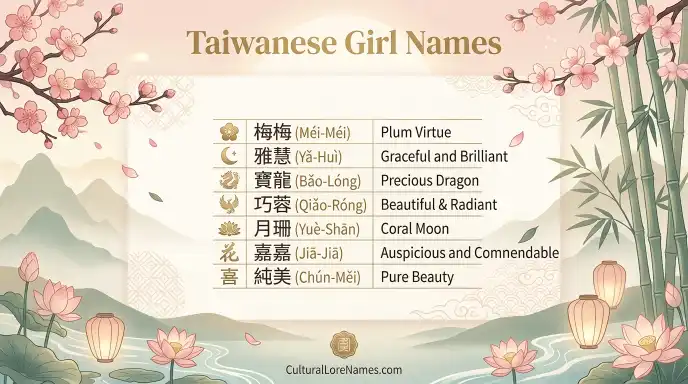
Taiwanese girl names offer a beautiful blend of tradition, modern style, and meaningful Chinese characters. Many names reflect ideas such as beauty, nature, wisdom, grace, and kindness.
The meaning can change depending on the characters chosen, so the original Chinese spelling matters. Taiwan also has diverse cultural traditions, including Indigenous naming practices.
This guide explores elegant, traditional, modern, cute, short, and nature-inspired names while explaining how naming order, pronunciation, characters, and cultural context can help you choose a name that feels natural and meaningful.
What Are Taiwanese Girl Names?
Taiwanese girl names can refer to several naming traditions found in Taiwan. Many people use Chinese names with a family surname followed by a given name. Taiwan also has Indigenous peoples whose traditional naming customs differ from Han Chinese naming patterns.
For a general name list, the most useful approach is to focus on Chinese given names used in Taiwan while recognizing Taiwan’s wider cultural diversity.
A Taiwanese-style Chinese name commonly includes:
- A family surname
- A one- or two-character given name
- Chinese characters with specific meanings
- A Mandarin pronunciation in many contexts
- A Romanized form when written in English
The same given-name sound can sometimes be written with different characters. That means the kanji-style assumption used for Japanese names does not apply here. Chinese characters can have different readings and meanings, so the written form matters.
Beautiful Taiwanese Girl Names
Here are some elegant choices that fit the style many readers expect when searching for Taiwanese girl names.
| Name | Meaning or Association | Style |
| Mei | Beauty | Classic |
| Mei-Ling | Beauty and delicacy, depending on characters | Traditional |
| Ya-Ting | Elegant or graceful qualities, depending on characters | Modern |
| Jia | Good, fine, or beautiful in common character uses | Simple |
| Jia-Yi | Goodness, justice, or appropriate qualities depending on characters | Elegant |
| Xin-Yi | Can express joy, sincerity, or other qualities depending on characters | Modern |
| Yu-Ting | Can carry associations with jade, rain, or elegance depending on characters | Graceful |
| Pei | Often used in names with meanings connected to admiration, cultivation, or jade-related characters | Refined |
| Wen | Culture, learning, or refinement in common uses | Intellectual |
| Hui | Wisdom or intelligence in common character uses | Classic |
Important: English spellings alone do not establish one fixed meaning. The exact Chinese characters should always be checked before assigning a definitive meaning.
Traditional Taiwanese Girl Names
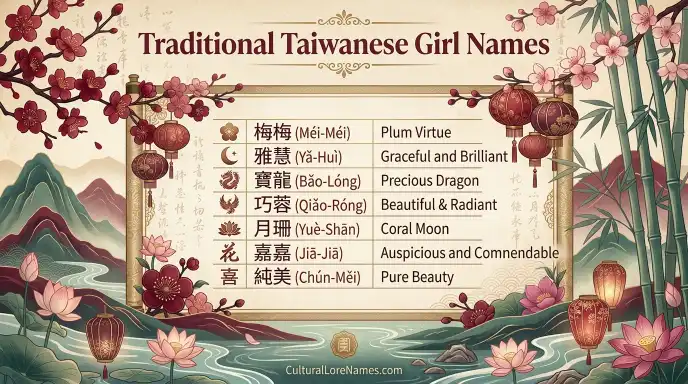
Traditional names can have a graceful and timeless quality. Some older naming patterns use characters associated with beauty, virtue, wisdom, flowers, jade, or gentleness.
Examples include:
- Mei
- Mei-Ling
- Mei-Hua
- Hui-Lan
- Li-Hua
- Fang
- Fang-Mei
- Xiu-Lan
- Wen-Hui
- Yu-Lan
Some of these forms may feel more old-fashioned or traditional to contemporary speakers. That can make them useful for historical characters, family-inspired names, or anyone seeking a classic style.
Modern Taiwanese Girl Names
Modern names often favor names that are short, clear, elegant, and easy to use internationally.
Some style ideas include:
- Jia
- Yi
- An
- Xin
- Lin
- Yun
- Ting
- Rui
- Ying
- Jing
A modern name does not need to be newly created. Older Chinese characters can still feel contemporary when used in newer combinations.
For an English-speaking family, a short Romanized form may also be easier to pronounce and remember. However, the original Chinese characters should remain the main reference when researching meaning.
Cute Taiwanese Girl Names
If you want something soft, sweet, and youthful, consider names with gentle sounds or positive meanings.
Some ideas include:
- Mei
- Jia
- Ning
- Xin
- Yue
- An
- Lin
- Ting
- Ying
- Xiao-Yu
For a real personal name, focus on the Chinese characters and actual naming usage, not just how cute the Romanized spelling looks.
For fictional characters or pets, you have much more creative freedom.
Taiwanese Girl Names Inspired by Nature
Nature provides many attractive naming themes in Chinese-language naming.
Flower-Inspired Names
Common character themes can include:
- Hua : flower
- Lan : orchid
- Mei : can refer to plum blossom or beauty depending on the character
- Lian : lotus
- Ju : chrysanthemum in the appropriate character
These names can create a delicate and poetic feeling.
Jade and Precious-Gem Themes
Chinese names often use characters associated with jade and precious materials.
Examples include:
- Yu
- Lin
- Zhu
- Bi
The exact meaning depends on the character selected. This is another reason to verify the Chinese spelling before translating a name.
Sky, Light, and Seasonal Themes
Nature-related concepts can also include:
- Yue : moon in a common character
- Xing : star in a common character
- Xia : summer or sunset-related meanings depending on the character
- Chen : can have several meanings depending on the character
These options work especially well for readers who want a poetic naming theme.
Short Taiwanese Girl Names
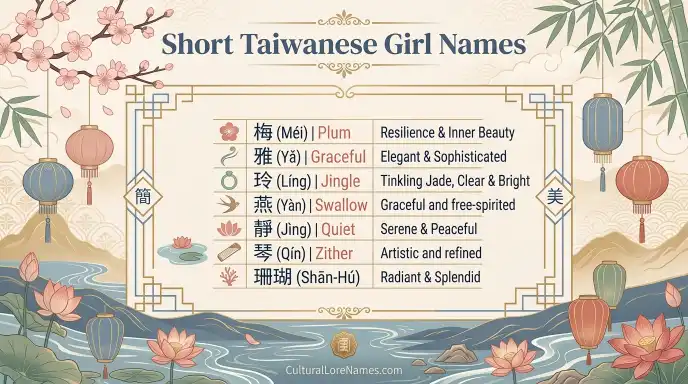
Short names are easy to remember and can work well in both Chinese and international settings.
Consider:
| Name | Style |
| An | Calm and simple |
| Jia | Bright and elegant |
| Mei | Classic and feminine |
| Xin | Modern and versatile |
| Lin | Soft and refined |
| Yue | Poetic |
| Rui | Elegant |
| Ying | Graceful |
| Hui | Classic |
| Jing | Refined |
One-character given names can sound especially clean and distinctive. Two-character given names are also common and offer more room for combining meanings.
Taiwanese Girl Names With Beautiful Meanings
The meaning of a Chinese name comes from its characters, not simply its Romanized pronunciation.
For example, a sound such as Mei can correspond to different Chinese characters. One may refer to beauty, while another can refer to a plum.
This creates an important naming rule:
Always check the exact Chinese characters before giving a name a fixed meaning.
Some useful meaning themes include:
Beauty
- Mei
- Li
- Yan
Wisdom
- Hui
- Zhi
- Wen
Kindness and Virtue
- Shan
- De
- Ren
Nature
- Lan
- Lian
- Yue
- Hua
- Mei
These are meaning themes, not claims that every Romanized version has exactly one definition.
Two-Character Taiwanese Girl Names
Two-character given names can create a balanced and meaningful combination.
Examples include:
- Mei-Ling
- Ya-Ting
- Xin-Yi
- Jia-Yi
- Yu-Ting
- Wen-Hui
- Li-Hua
- Hui-Lan
- Jia-Xin
- Yi-Jing
The hyphen in these examples is only a convenient way to show the two parts in English. Actual Romanization practices can vary.
When choosing a two-character name, consider if the characters create a coherent meaning together, rather than selecting each character separately.
How Are Names Written in Taiwan?
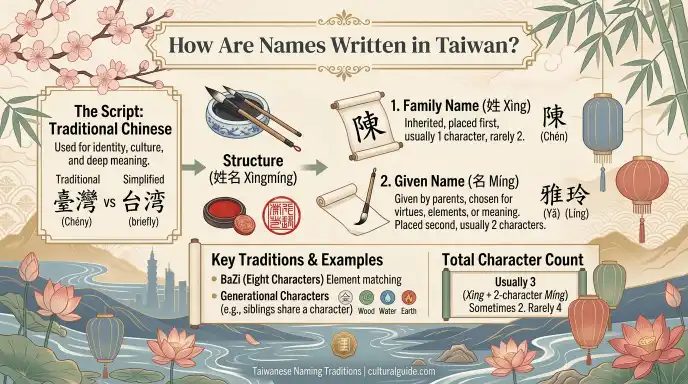
For Chinese names, Taiwan’s naming rules place the surname first and the given name second. The current Name Act also states that Chinese names used for official registration follow specified character requirements.
For example, a fictional name could be shown as:
Chen Jia-Yi
Here:
- Chen is the family name.
- Jia-Yi is the given name.
In Chinese characters, the name would normally be written without inserting a space between the surname and given name for official Chinese-name registration.
English-language materials may use different spacing or Romanization conventions, so written forms can vary outside official Chinese contexts.
What Makes a Name Specifically Taiwanese?
There is an important difference between a Chinese name used in Taiwan and a name that is uniquely Taiwanese.
Taiwan shares a large Chinese linguistic and cultural naming tradition with other Chinese-speaking societies. Therefore, many names used in Taiwan are also found elsewhere.
At the same time, Taiwan has its own local history, language communities, naming preferences, and Indigenous traditions.
For this reason, “Taiwanese girl name” is best understood as a cultural and geographic naming context, not a completely separate list of names that exist only in Taiwan.
Taiwanese Indigenous Girl Names
Taiwan is home to multiple Indigenous peoples with their own languages and naming traditions. These traditions should not simply be replaced with Chinese names when discussing Taiwanese naming culture.
Taiwan’s current Name Act recognizes Indigenous naming customs and allows traditional Indigenous names to be registered according to those cultural conventions.
This is important because Indigenous Taiwanese names are not a single naming system. Different peoples have distinct languages and traditions.
If you are specifically looking for an Indigenous Taiwanese girl name, the best approach is to identify the specific Indigenous people or language tradition first.
That avoids mixing unrelated cultures into one generic category.
Taiwanese Girl Names for Characters
Taiwanese names can be useful for novels, films, games, and other fictional characters.
Choose the name based on the character’s:
- Age
- Family background
- Setting
- Generation
- Personality
- Cultural background
- Time period
A contemporary teenage character should not automatically receive a name that feels strongly associated with an older generation.
For historical fiction, the time period matters even more.
A realistic character name should also include an appropriate family surname and given name combination, rather than using an attractive given name in isolation.
How to Choose a Taiwanese Girl Name
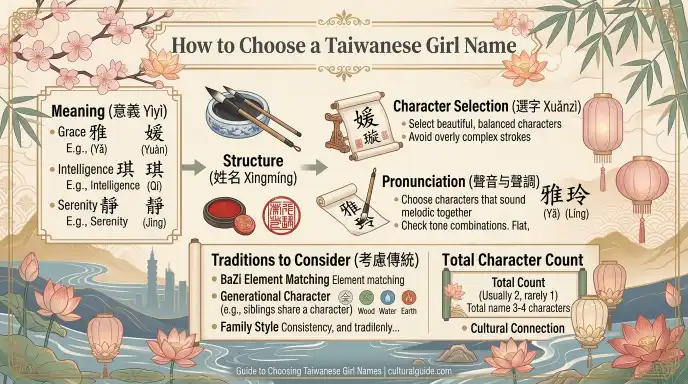
Start with the meaning and cultural context you want. Then check the actual Chinese characters.
Choose a theme
You might want a name connected with:
- Beauty
- Nature
- Wisdom
- Kindness
- Strength
- Grace
- Family
- Flowers
- Jade
- Light
Choose the sound
Say the Romanized name aloud. Make sure it feels comfortable in the languages your family uses.
Check the characters
This is one of the most important steps. Romanization can hide differences in meaning.
Consider the surname
The given name should sound natural with the family surname.
Think about age and generation
Some names may feel traditional, while others have a more contemporary impression.
Check cultural context
If you want an Indigenous Taiwanese name, identify the specific cultural tradition instead of using a general Chinese name.
Common Mistakes When Choosing Taiwanese Girl Names
Several mistakes can make a name feel less accurate or less natural.
Treating Every Chinese Name as Uniquely Taiwanese
Many Chinese names are shared across different regions. A name being used in Taiwan does not automatically make it exclusive to Taiwan.
Relying Only on Romanization
Romanized spelling is not enough to establish meaning. Check the original Chinese characters.
Translating Characters Too Literally
A dictionary meaning may not capture the way a character functions in a personal name.
Mixing Different Cultural Traditions
Taiwan has Han Chinese and Indigenous naming traditions, among others. These should not be presented as one identical system.
Ignoring the Generation
A name can be perfectly valid yet sound strongly associated with a particular age group or era.
Taiwanese Girl Names vs. Chinese Girl Names
These terms overlap, but they are not identical.
| Term | What It Usually Refers To |
| Taiwanese girl names | Names used in Taiwan or connected with Taiwanese naming culture |
| Chinese girl names | A much broader category covering Chinese-language naming traditions |
| Mandarin names | Names or pronunciations associated with Mandarin Chinese |
| Taiwanese Indigenous names | Names from Indigenous peoples and their individual cultural traditions |
| Taiwanese Hokkien names | Naming or language traditions connected with Taiwanese Hokkien |
This distinction helps prevent a common mistake: assuming that one list of Chinese names represents all of Taiwan.
Frequently Asked Questions
Q1. What are some beautiful Taiwanese girl names?
Beautiful options include Mei, Jia, Xin, Hui, Yu, Lin, Lan, Lian, Yue, and Jing. The exact meaning depends on the Chinese characters used, so the written form should be checked before choosing a name.
Q2. What is a popular style for Taiwanese girl names?
Many Taiwanese Chinese names use one- or two-character given names after the family surname. Modern choices often favor simple sounds and positive meanings, while traditional names may emphasize beauty, virtue, nature, or family values.
Q3. Do Taiwanese girl names have meanings?
Yes. Chinese characters can carry specific meanings, so many given names have intentional meanings. However, one Romanized pronunciation can correspond to different characters, which means the meaning cannot always be determined from English spelling alone.
Q4. What are some short Taiwanese girl names?
Short options include Mei, Jia, An, Xin, Lin, Yue, Hui, Rui, Ying, and Jing. Some can be written as one-character given names, while others may appear as part of longer names.
Q5. Are Taiwanese girl names the same as Chinese girl names?
Not exactly. There is substantial overlap, but Taiwan has its own naming practices and diverse cultural traditions. Chinese names used in Taiwan may also be used in other Chinese-speaking communities.
Q6. Do Taiwanese names put the surname first?
Yes. Taiwan’s current naming rules specify surname first and given name second for Chinese-language names.
Q7. Are there traditional Indigenous Taiwanese girl names?
Yes. Taiwan’s Indigenous peoples have their own naming traditions and languages. The current legal framework recognizes traditional Indigenous naming customs.
Q8. How do I choose a Taiwanese girl name with the right meaning?
Start with the meaning you want, then choose suitable Chinese characters. Check the pronunciation, character meanings, surname combination, and cultural context before making the final choice.
Conclusion:
Taiwanese girl names offer much more variety than a simple list of Chinese names suggests. Traditional and modern choices can express beauty, wisdom, nature, grace, and other qualities, while Taiwan’s Indigenous communities add further naming traditions.
For the most accurate choice, focus on the original characters, pronunciation, cultural context, and complete name rather than relying on Romanized spelling alone.

I’m Mia Carter, a language enthusiast and writer passionate about making grammar, words, and everyday communication simple and easy to understand. I enjoy sharing clear, practical insights that help readers communicate with confidence.