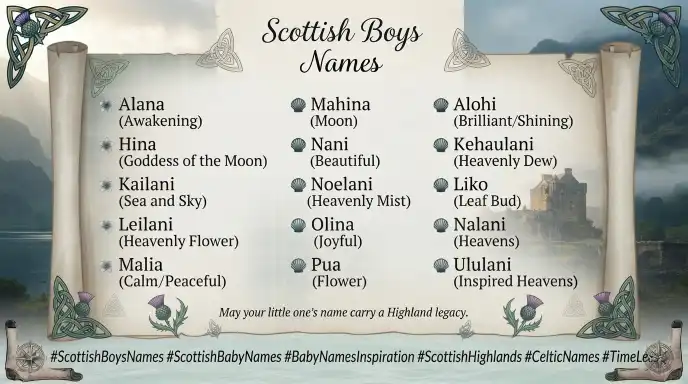
Scottish boys names include traditional Gaelic names, historic Scottish names, and distinctive choices inspired by Scotland’s culture and landscapes. Popular options include Alasdair, Angus, Callum, Ewan, Finlay, Hamish, Lachlan, and Fergus.
Some have deep Gaelic roots, while others reflect Scotland’s long history of language, family traditions, and cultural exchange. If you want a traditional Scottish boy name, a rare Gaelic name, or a modern choice with Scottish roots, the best option depends on the sound, meaning, and heritage you value.
However, Scottish names can have different spellings and pronunciations, so understanding their backgrounds can help you choose wisely. This guide explores traditional Scottish boys names, unique Gaelic names, short names, modern choices, and historically significant names. You will also find meaningful explanations, practical selection tips, and answers to common questions.
Scottish Boys Names : Quick Answer
Some of the best Scottish boys names are Alasdair, Angus, Callum, Ewan, Finlay, Hamish, Lachlan, Malcolm, and Fergus. These names offer a mix of Gaelic heritage, Scottish history, and familiar modern usage.
Here are several options to consider:
| Name | Meaning or background |
| Alasdair | Scottish Gaelic form of Alexander, associated with “defender of men” |
| Angus | From Gaelic elements traditionally interpreted as “one” and “choice” |
| Callum | Scottish form of Columba, a Latin name meaning “dove” |
| Ewan | Scottish name with Gaelic and related historical forms |
| Finlay | Traditionally interpreted as “fair warrior” |
| Hamish | Scottish form associated with James |
| Lachlan | Traditionally linked with the land of the lochs or fjords |
| Malcolm | Associated with a devotee or disciple of Saint Columba |
| Fergus | Commonly interpreted as “man of strength” |
| Iain | Scottish Gaelic form of John |
Note: Name meanings can vary across historical and linguistic sources. Treat traditional interpretations as guides when the evidence is not definitive.
Traditional Scottish Boys Names
Traditional Scottish boys names often come from Scottish Gaelic, older Celtic languages, Norse influences, and names used by Scottish families for generations. Some are linked to kings, clans, saints, and historic figures. Others remain familiar because they have simple spellings and strong cultural roots.
Consider these classic Scottish names if you want something with a long history.
| Name | Background |
| Alastair | Scottish form associated with Alexander |
| Angus | Traditional form of Aonghas |
| Archibald | Historic name with the familiar nickname Archie |
| Bruce | Associated with Scottish royal history and family heritage |
| Duncan | Traditional Scottish name with Gaelic roots |
| Fergus | Ancient Gaelic name |
| Gordon | Scottish surname also used as a given name |
| Hamish | Scottish form associated with James |
| Kenneth | Traditional name with Gaelic and Pictish associations |
| Malcolm | Historic Scottish royal name |
| Murdoch | Traditional name with Gaelic and Norse connections |
| Robert | Long established in Scottish history |
| Wallace | Scottish surname associated with William Wallace |
| Walter | Traditional name found in Scottish history |
| William | Long established across Scotland |
Best choices: Angus, Duncan, Fergus, Hamish, and Malcolm suit readers who want a traditional Scottish feel. Meanwhile, Archie and William offer familiar options that work well in many English-speaking countries.
Scottish Gaelic Boys Names
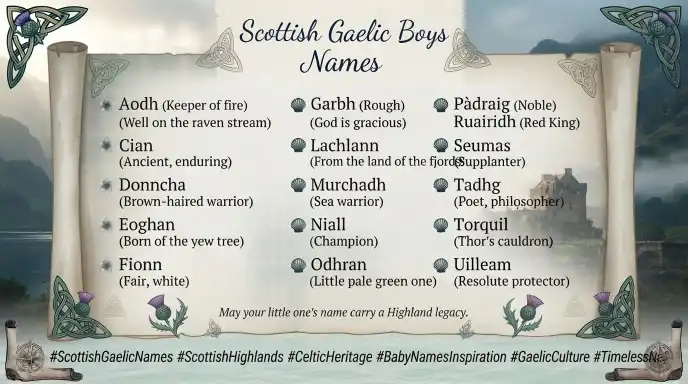
Scottish Gaelic boys names offer a closer connection to the language and naming traditions of Gaelic-speaking Scotland. Some have familiar English forms, while others retain distinctive spellings and accents.
These names can be especially appealing if you want a name with Scottish linguistic heritage.
| Scottish Gaelic name | English form or related name |
| Ailean | Alan or Allan |
| Aindrea | Andrew |
| Alasdair | Alexander |
| Aonghas | Angus |
| Artair | Arthur |
| Calum | Callum |
| Daibhidh | David |
| Dòmhnall | Donald |
| Eòghann | Ewan or related Owen forms |
| Iain | Ian or John |
| Murchadh | Murdoch |
| Raibeart | Robert |
| Seumas | James |
| Tòmas | Thomas |
| Uilleam | William |
Some Gaelic names have more than one English spelling, and their relationships can vary by historical period and regional usage. For example, Calum and Callum are closely related forms, while Alasdair and Alexander represent Gaelic and English forms of the same name.
If you choose a Gaelic spelling, check its pronunciation and written form with a reliable Scottish Gaelic language resource. This is especially useful for names containing accents or letter combinations unfamiliar to English speakers.
Unique Scottish Boys Names
Unique Scottish boys names are ideal if you want something less familiar than William, James, or Robert. You can explore old Gaelic forms, uncommon traditional names, and names associated with Scottish places and history.
The following choices offer different levels of familiarity.
| Name | Why consider it |
| Aodh | Short Gaelic name with an old Celtic background |
| Ailpein | Traditional Gaelic form related to Alpin |
| Aonghas | Gaelic spelling of Angus |
| Beathan | Traditional Gaelic name |
| Bhaltair | Gaelic form of Walter |
| Coinneach | Traditional Gaelic name related to Kenneth |
| Domnall | Older form related to Donald |
| Eòin | Gaelic name form associated with John |
| Fionnlagh | Gaelic form associated with Finlay |
| Gillebrìghde | Traditional Gaelic name with religious roots |
| Lachlann | Gaelic form related to Lachlan |
| Neacal | Gaelic form of Nicholas |
| Raghnall | Gaelic form related to Ranald or Ronald |
| Somhairle | Gaelic name with Norse roots |
| Tormod | Traditional Gaelic name with Norse connections |
Aonghas, Fionnlagh, and Somhairle stand out if you prefer distinctive cultural spellings. For a shorter option, Aodh is memorable, although its pronunciation may need explanation outside Gaelic-speaking communities.
Remember that an uncommon spelling is not always a rare name in its original language. Check local usage before treating a name as unusual or historically rare.
Scottish Boys Names With Strong Meanings
Some people choose Scottish boys names with strong meanings because they want a name linked to courage, leadership, wisdom, or strength. However, meanings can change across languages and historical forms. Therefore, it is important to avoid assigning a symbolic meaning without good evidence.
Here are several names with commonly cited interpretations or strong historical associations.
| Name | Meaning or association |
| Alasdair | Defender of men, through its relationship to Alexander |
| Angus | Traditionally interpreted as “one choice” or “unique choice” |
| Duncan | Often interpreted through Gaelic elements associated with dark or brown and a warrior |
| Fergus | Commonly interpreted as “man of strength” |
| Finlay | Traditionally interpreted as “fair warrior” |
| Malcolm | Associated with a devotee or disciple of Saint Columba |
| Robert | Commonly interpreted through Germanic elements meaning fame and bright |
| Wallace | Strong association with Scottish history through William Wallace |
| William | Commonly interpreted as “resolute protector” |
| Kenneth | Has several proposed historical explanations, so a single meaning requires caution |
If meaning matters most, Alasdair, Fergus, Finlay, and William are useful starting points. If you care more about historical identity, Malcolm and Wallace offer notable associations with Scotland’s past.
A name’s historical story and its literal linguistic meaning are not always the same. Consider both when deciding which name best fits your preferences.
Short Scottish Boys Names
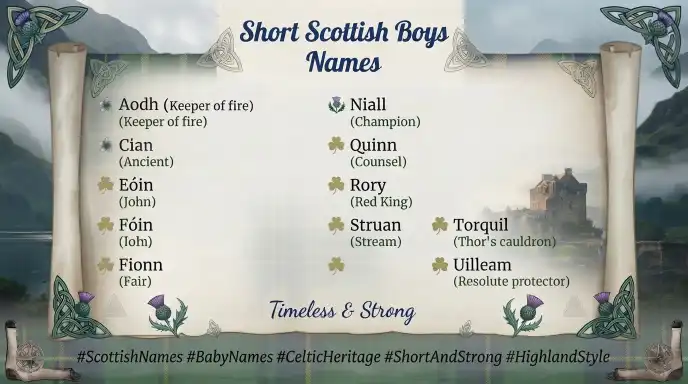
Short Scottish boys names can be easy to say, simple to write, and convenient in everyday life. Some are traditional Gaelic forms, while others are familiar names used in Scotland.
| Name | Style |
| Aodh | Short and traditional Gaelic |
| Alec | Familiar and classic |
| Blair | Modern, unisex-friendly Scottish name |
| Calum | Scottish Gaelic form |
| Craig | Linked to a rocky landscape |
| Ewan | Familiar Scottish choice |
| Ian | Short form associated with Scottish usage |
| Iain | Gaelic form of John |
| Kyle | Scottish place-name connection |
| Ross | Scottish surname and place-name usage |
| Roy | Short traditional choice |
| Scott | Name linked directly to Scottish identity |
Calum, Ewan, Iain, and Ross are strong choices if you want a compact name with Scottish associations. Meanwhile, Blair and Kyle may appeal if you prefer a more contemporary sound.
Pronunciation can still vary, even with short names. For example, Iain is commonly pronounced like Ian, so a brief pronunciation check can help avoid confusion.
Modern Scottish Boys Names
Modern Scottish boys names often balance cultural heritage with a sound that feels familiar today. Some traditional names have become widely used beyond Scotland, while others appeal because they work across different languages and cultures.
Consider these options if you want a name that feels both rooted and current.
| Name | Why it may appeal |
| Callum | Familiar, approachable, and linked to Scottish Gaelic |
| Cameron | Established Scottish surname used as a given name |
| Finlay | Traditional roots with a contemporary feel |
| Fraser | Scottish surname with a polished sound |
| Hamish | Distinctive yet established |
| Lachlan | Strong Scottish heritage and international recognition |
| Logan | Scottish place-name and surname background |
| Murray | Traditional Scottish surname used as a given name |
| Ross | Short and straightforward |
| Rory | Friendly, compact, and associated with Gaelic naming traditions |
Popularity depends on the country and year. A name that feels modern in one place may be well established in another.
If you want a name that is easy to use internationally, Callum, Cameron, Finlay, Logan, and Ross are practical starting points. If a stronger traditional character matters more, consider Hamish or Lachlan.
Scottish Boys Names Inspired by Nature and Landscapes
Scotland is known for its lochs, glens, rugged hills, islands, and rivers. Names connected to Scottish places can offer a subtle link to this landscape without requiring a literal nature-themed name.
| Name | Nature or place connection |
| Blair | Connected to a Scottish place-name element meaning a plain or field |
| Clyde | Named after the River Clyde |
| Craig | Means a rocky outcrop or crag in Scottish and related usage |
| Glen | Refers to a narrow valley |
| Kyle | Associated with a narrow strait or channel in Scottish place names |
| Logan | Linked to Scottish place names and a surname tradition |
| Murray | Scottish family and geographic associations |
| Ross | Scottish regional and surname connections |
These names differ in how directly they refer to nature. Craig and Glen have clear landscape associations, while Clyde connects to a major Scottish river. Blair and Kyle are useful choices if you prefer a place-inspired name that also feels natural as a first name.
Scottish Boys Names From History and Royal Tradition
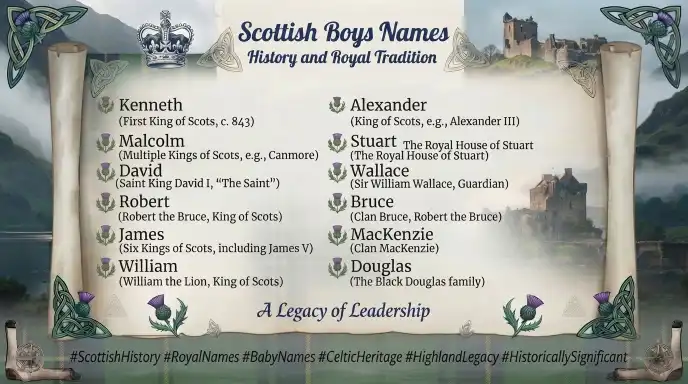
Scottish history offers many names connected with rulers, historic families, independence, and Gaelic traditions. These associations can make a name feel meaningful, especially if you have Scottish ancestry or an interest in the country’s past.
| Name | Historical connection |
| Alexander | Used by several Scottish kings |
| Angus | Associated with old Gaelic naming traditions |
| Bruce | Linked with Robert the Bruce |
| David | Used by Scottish kings, including David I |
| Donald | Appears in the history of Scottish rulers and clans |
| Duncan | Associated with the historical King Duncan I |
| James | Used by many Scottish kings |
| Kenneth | Connected with early Scottish royal history |
| Malcolm | Used by several Scottish kings |
| Robert | Associated with Robert the Bruce |
| Wallace | Linked with William Wallace and the Wars of Scottish Independence |
| William | Used by Scottish historical figures and monarchs |
A historical association does not always mean a name originated in Scotland. James, David, Alexander, and William have roots beyond Scottish culture, but their use in Scottish history makes them relevant choices.
If you want a name with a clear story, Robert, Malcolm, Kenneth, and Wallace are worth exploring. Choose based on the historical connection you find meaningful rather than assuming every famous name has a uniquely Scottish origin.
Scottish Boys Names That Are Easy to Pronounce
Some people want a Scottish name that is easy to use in daily life, especially if they live outside Scotland. Familiar spellings can reduce confusion, although pronunciation may still vary by region.
Here are options that many English speakers will recognize.
| Name | Pronunciation guidance |
| Angus | ANG-gus |
| Callum | KAL-um |
| Cameron | KAM-er-un |
| Duncan | DUN-kan |
| Ewan | YOO-an |
| Finlay | FIN-lay |
| Hamish | HAY-mish |
| Ian | EE-an |
| Lachlan | Commonly LOCK-lan |
| Malcolm | MAL-kum |
| Ross | ROSS |
| Scott | SKOT |
Pronunciation guides are approximate. Scottish accents and local speech patterns can affect the way a name sounds, and Gaelic spellings may not follow English reading patterns.
If easy pronunciation is your main concern, Angus, Callum, Cameron, Duncan, and Ross are practical choices. If you love a less familiar Gaelic name, you can still choose it and share its pronunciation with others.
Scottish Boys Names by Style
Comparing names by style can make your shortlist easier to manage. Rather than looking only at meanings, think about if you prefer a classic, rare, short, or contemporary sound.
| Your preferred style | Names to consider |
| Traditional | Angus, Duncan, Fergus, Malcolm |
| Gaelic | Alasdair, Aonghas, Calum, Iain |
| Unique | Aodh, Bhaltair, Somhairle, Tormod |
| Short | Alec, Iain, Ross, Roy |
| Modern | Callum, Cameron, Finlay, Logan |
| Nature-inspired | Blair, Craig, Glen, Kyle |
| Historical | Bruce, Kenneth, Malcolm, Robert |
| Easy to recognize | Angus, Cameron, Ian, Scott |
These groups are guides rather than strict categories. A name can fit more than one style, and a traditional name may also feel modern depending on where it is used.
How to Choose the Right Scottish Boy Name

The right Scottish boy name should suit your preferred sound, its cultural background, and the way you plan to use it. You do not need to choose the rarest or oldest option. A familiar name with a genuine connection to Scotland may be a better fit than an obscure name with uncertain origins.
Use these steps to narrow your choices.
- Decide what Scottish means to you. You may prefer Gaelic language roots, Scottish history, family ancestry, or place names.
- Check the meaning carefully. Compare reliable explanations, especially when different sources give different interpretations.
- Say the name aloud. Try it with your surname and any middle names you are considering.
- Check the spelling. Gaelic names may include accents or forms that differ from their English equivalents.
- Think about daily use. Consider if you prefer a name that is easy to recognize or one that invites questions about its heritage.
- Consider family connections. A name linked to a relative, clan, or meaningful Scottish place can offer a personal connection.
- Choose the form you prefer. For example, you might prefer Alasdair over Alistair, or Calum over Callum, depending on your linguistic and stylistic preferences.
A useful final test is to choose three favorite names and use each one in a full sentence. This helps you compare how each name sounds and feels in everyday life.
Common Mistakes When Choosing Scottish Boys Names
A name may look Scottish in spelling without having a Scottish origin. Likewise, a name used in Scotland may have developed from another language. Keeping these differences in mind helps you make a more informed choice.
Avoid these common mistakes:
- Assuming every Celtic name is Scottish. Irish, Welsh, and Scottish naming traditions overlap in some ways but are not interchangeable.
- Treating every meaning as certain. Some names have disputed or incomplete etymologies.
- Confusing Gaelic and English forms. Related names may have different spellings and pronunciation patterns.
- Choosing a name only because it is rare. An uncommon name is not automatically more authentic or meaningful.
- Ignoring pronunciation. Check how a name is spoken in its original language if this matters to you.
- Assuming surname origins prove a given name’s origin. A Scottish surname may be used as a first name, but that does not mean it began as a personal name.
The most useful approach is to balance cultural accuracy, personal meaning, and everyday practicality.
Frequently Asked Questions
Q1. What are the most traditional Scottish boys names?
Traditional Scottish boys names include Angus, Duncan, Fergus, Hamish, Kenneth, Malcolm, and Iain. These names reflect Gaelic heritage, long-standing Scottish usage, or historical connections.
Some have familiar English forms, while others preserve spellings associated with Scottish Gaelic.
Q2. What are some unique Scottish boys names?
Distinctive choices include Aodh, Aonghas, Bhaltair, Fionnlagh, Somhairle, and Tormod. These names offer links to Scottish Gaelic and older naming traditions. However, how unusual a name feels depends on the region, language, and community where it is used.
Q3. What are Scottish Gaelic boys names?
Scottish Gaelic boys names include Alasdair, Ailean, Aonghas, Calum, Daibhidh, Iain, Seumas, and Uilleam. Many have related English forms, such as Alexander, Alan, Angus, Callum, David, Ian, James, and William. Gaelic spelling and pronunciation can differ from their English counterparts.
Q4. What Scottish boy names have strong meanings?
Alasdair, Fergus, Finlay, and William are useful choices if you like names with commonly cited meanings connected to defense, strength, heroism, or protection. Historical meanings can vary by source, so check the etymology rather than relying only on a modern baby-name interpretation.
Q5. What are short Scottish boys names?
Short options include Alec, Blair, Calum, Ewan, Iain, Ross, Roy, and Scott. These names are relatively compact and easy to use in everyday settings. If you want a name with a more traditional Gaelic appearance, Iain or Calum may suit you.
Q6. What Scottish boys names are easy to pronounce?
Angus, Callum, Cameron, Duncan, Finlay, and Ross are recognizable choices for many English speakers. Their pronunciation is generally more familiar than that of less common Gaelic forms. Still, local accents can change how a name sounds.
Q7. Are Scottish boys names always Gaelic?
No. Scottish boys names come from several linguistic and cultural traditions, including Gaelic, Brittonic, Norse, Anglo-Norman, and other European influences. Some names are associated with Scottish places or surnames rather than originating as Gaelic personal names.
Q8. What Scottish boy names are inspired by nature?
Craig, Glen, and Clyde offer clear landscape or geographic connections. Blair and Kyle are also associated with Scottish place-name traditions. These options can suit someone who wants a subtle connection to Scotland’s hills, valleys, rivers, or historic geography.
Conclusion:
Scottish boys names offer a wide range of choices, from familiar classics like Angus, Callum, and Duncan to distinctive Gaelic names like Aonghas, Fionnlagh, and Somhairle. Each style offers a different connection to Scotland’s language, history, and culture.
Before making your final choice, check the name’s origin, pronunciation, and meaning. Most importantly, choose a name that feels right to you, if you prefer a traditional Scottish name or a distinctive Gaelic form.

I’m Mia Carter, a language enthusiast and writer passionate about making grammar, words, and everyday communication simple and easy to understand. I enjoy sharing clear, practical insights that help readers communicate with confidence.