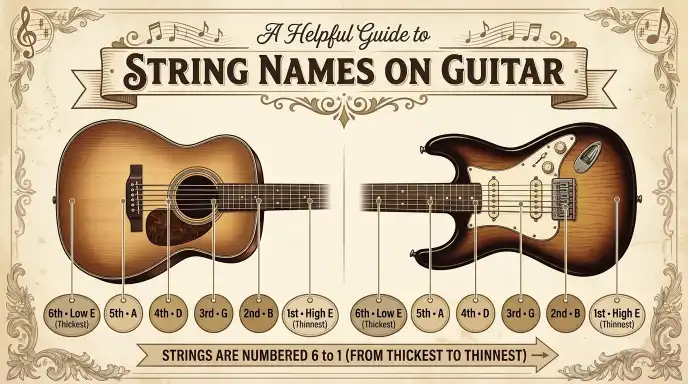
String names on guitar refer to the six strings of a standard guitar, each tuned to a specific note. From the thickest string to the thinnest, the names are E, A, D, G, B, and E.
The thickest string is called the low E string, while the thinnest is called the high E string. Learning these names helps you tune your guitar, read tabs, play chords, and follow guitar lessons with ease.
Guitar String Names and Numbers
A standard guitar has six strings. Each string has a number and a note name. The 6th string is the thickest, while the 1st string is the thinnest. This numbering may feel backward at first, but it becomes easy with practice.
| String Number | String Name | Thickness | Pitch |
| 6th string | Low E | Thickest | Lowest |
| 5th string | A | Thick | Low |
| 4th string | D | Medium-thick | Mid-low |
| 3rd string | G | Medium | Mid-high |
| 2nd string | B | Thin | High |
| 1st string | High E | Thinnest | Highest |
The names above refer to the notes you hear when you play the strings without pressing any frets. These are called open strings. Standard tuning follows the same E–A–D–G–B–E order on most six-string acoustic and electric guitars.
Guitar String Names From Thickest to Thinnest
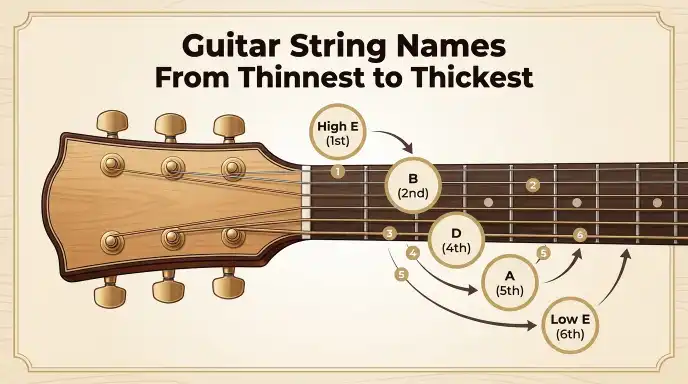
The easiest way to learn the string names is to start with the thickest string and move toward the thinnest one. The notes follow this order:
E → A → D → G → B → E
- Low E: The thickest string, which produces the lowest note in standard tuning.
- A string: The fifth string, often used in bass notes for chords.
- D string: The fourth string, found in many common chord shapes.
- G string: The third string, which sits near the middle of the guitar.
- B string: The second string, located close to the thinnest string.
- High E: The thinnest string, which produces the highest open-string note.
Notice that E appears twice. Both strings have the same letter name, but they sound in different octaves. The low E sounds deeper, while the high E sounds brighter and higher.
Guitar String Names From Thinnest to Thickest
You may also see guitar strings listed in the opposite direction. This order starts with the thinnest string and moves toward the thickest.
| Order | String Name | Common Label |
| 1 | E | High E |
| 2 | B | B string |
| 3 | G | G string |
| 4 | D | D string |
| 5 | A | A string |
| 6 | E | Low E |
This reverse order is useful when reading guitar chord diagrams and tablature. In standard guitar notation, the 1st string is the high E string, and the 6th string is the low E string.
Easy Ways to Remember Guitar String Names
Memorizing six letters can seem tricky at first. Fortunately, a short phrase can help you recall the correct order.
For the thickest string to the thinnest, remember E,A,D,G,B,E.
Here are a few memory tricks:
- Every Amateur Does Get Better Eventually
- Eddie Ate Dynamite, Good Bye Eddie
- Eat All Day, Get Big Easy
Each word starts with the same letter as a guitar string. As a result, you can use the phrase to recall the notes in order.
You can also create your own sentence. Choose words that are easy to remember, then repeat the phrase while pointing to each string. With regular practice, you may soon remember the names without needing the sentence.
Why Are Guitar Strings Numbered Backward?
Guitar string numbers can confuse beginners because the numbering starts at the thinnest string, not the thickest. The 1st string is high E, while the 6th string is low E.
This system gives each string a fixed number. Guitar tabs and many chord diagrams use those numbers to show which string to play.
For example, a tab may show the number 3 on the 6th string. This means you should press the third fret of the low E string. However, a number placed on the 1st string refers to the high E string instead.
Remember this simple rule:
String 1 = thinnest. String 6 = thickest.
Once you learn the numbering, guitar tabs become easier to follow.
Guitar String Names Diagram
A simple text diagram can help you picture the order. The layout below lists the strings from thickest to thinnest.
The diagram shows the standard tuning order. When holding a guitar in a playing position, the low E string is closest to your head, while the high E string is closest to the floor.
Keep in mind that a guitar chord diagram may display the strings in a different visual direction. Check the labels or diagram layout before deciding which string is which.
What Notes Do Guitar Strings Make?
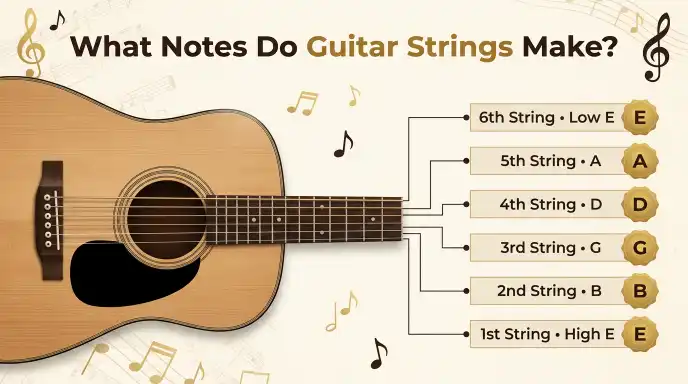
In standard tuning, each open string produces a note from the musical alphabet. The notes are E, A, D, G, B, and E. Pressing a string against a fret changes its pitch.
| String | Open Note | Example at the 1st Fret |
| 6th | E | F |
| 5th | A | A♯ or B♭ |
| 4th | D | D♯ or E♭ |
| 3rd | G | G♯ or A♭ |
| 2nd | B | C |
| 1st | E | F |
Each fret raises the pitch by one semitone. For example, pressing the first fret of the low E string produces F. Similarly, pressing the first fret of the high E string also produces F, but in a higher octave.
The notes B and C are next to each other in the musical alphabet, as are E and F. There is no natural note between these pairs, which is why their first-fret examples do not use sharps or flats.
Do Acoustic and Electric Guitars Have the Same String Names?
Yes. Most standard six-string acoustic and electric guitars use the same string names and tuning. Both usually follow E,A,D,G,B,E, from the thickest string to the thinnest.
| Guitar Type | Common Number of Strings | Standard Tuning |
| Acoustic guitar | 6 | E,A,D,G,B,E |
| Electric guitar | 6 | E,A,D,G,B,E |
| Classical guitar | 6 | E,A,D,G,B,E |
| Seven-string guitar | 7 | Varies by setup |
| Twelve-string guitar | 12 | Commonly paired strings |
Although acoustic and electric guitars share the same standard tuning, their strings may differ in material, thickness, and feel. A seven-string guitar has an extra string, while a twelve-string guitar uses paired strings.
Some players also use alternate tunings. For instance, Drop D changes the low E string to D. Therefore, check the tuning before using a standard string chart.
How to Tune Guitar Strings to the Correct Notes
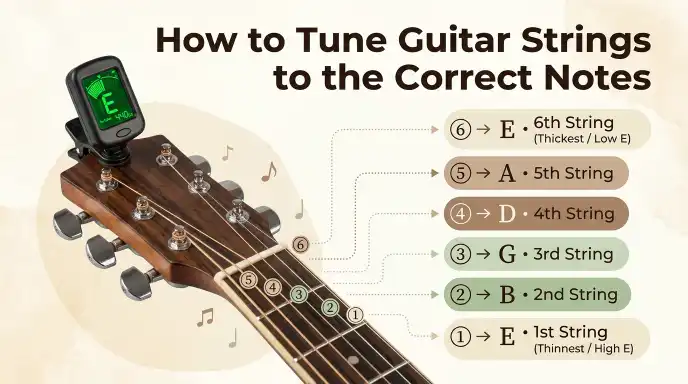
Knowing the string names helps you tune your guitar. A clip-on tuner or a reliable digital tuner can show if each string is too low or too high.
Follow these steps:
- Start with the low E string. Play the thickest string and check the tuner.
- Tune the A string. Move to the fifth string and adjust it until the tuner shows A.
- Continue with D and G. Check each string separately.
- Tune the B string. Make small adjustments until the tuner shows B.
- Finish with high E. Check the thinnest string and match it to E.
Play each string separately so the tuner can identify its note. If the reading is unclear, stop other strings from ringing.
Make small adjustments to the tuning pegs. Also, avoid turning a peg too far at once. The goal is to match each string to its correct note, not simply to make it sound higher or lower.
For a reliable reference, Fender provides an online guitar tuner with standard and alternate tuning options.
Common Mistakes When Learning Guitar String Names
Beginners often mix up the string numbers or forget which E string is which. A few simple reminders can help prevent these mistakes.
- Mixing up low E and high E: Both are E strings, but they sound in different octaves.
- Counting from the thickest string: The thickest is string 6, not string 1.
- Reading tabs from the wrong side: Check the tab layout before playing.
- Assuming every guitar uses standard tuning: Some players change one or more strings to different notes.
- Memorizing without practicing: Point to each string and say its name aloud to reinforce the order.
The most helpful habit is to name the string before playing it. For example, say “5th string, A” before plucking the A string. This simple exercise connects the string number with its note name.
Frequently Asked Questions
Q1. What are the names of the six guitar strings?
The six strings in standard tuning are E, A, D, G, B, and E, from thickest to thinnest. The first E is the low E string, while the last E is the high E string.
Q2. Which guitar string is number one?
The 1st string is the thinnest string, known as high E. It is closest to the floor when you hold the guitar in playing position.
Q3. Which guitar string is number six?
The 6th string is the thickest string, known as low E. It produces the lowest open note in standard tuning.
Q4. Why does a guitar have two E strings?
A standard guitar has a low E and a high E because the notes are in different octaves. Both strings share the letter name E, but they produce different pitches.
Q5. Are guitar string names the same for acoustic and electric guitars?
Yes. Most six-string acoustic and electric guitars use the same standard tuning: E,A,D,G,B,E. However, some players use alternate tunings.
Q6. How can I remember the guitar string names easily?
Use the phrase “Eddie Ate Dynamite, Good Bye Eddie.” Its first letters follow E,A,D,G,B ,E, from the thickest string to the thinnest.
Q7. What are the guitar strings called from thinnest to thickest?
The order is E, B, G, D, A, E, starting with high E and ending with low E. This is the reverse of the usual thickest-to-thinnest order.
Q8. Do guitar string names change when I press a fret?
Yes. Pressing a string against a fret raises its pitch. For example, the open low E string becomes F when you press the first fret.
Conclusion:
Learning the string names on guitar is one of the first steps for any beginner. In standard tuning, the strings follow E–A–D–G–B–E from thickest to thinnest. The 6th string is low E, and the 1st string is high E.
Use a string chart, practice the memory phrase, and name each string as you play. With regular practice, you will find it easier to tune your guitar, read tabs, and learn chords.

I’m Mia Carter, a language enthusiast and writer passionate about making grammar, words, and everyday communication simple and easy to understand. I enjoy sharing clear, practical insights that help readers communicate with confidence.