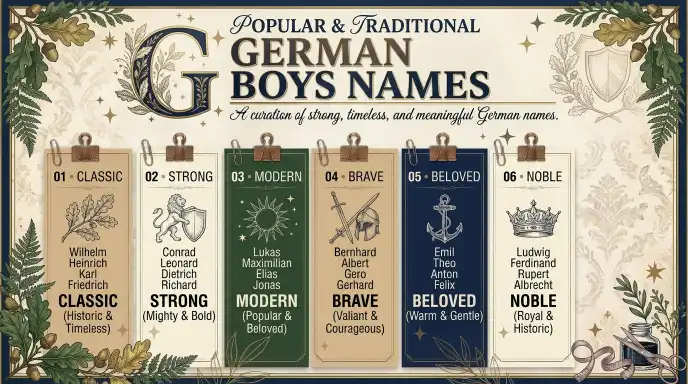
German boys names offer a wonderful mix of traditional charm, modern style, and meaningful origins. Popular choices like Leon, Felix, Emil, and Finn sound simple and stylish, while classic names such as Friedrich, Heinrich, and Ludwig reflect German heritage.
If you prefer a strong, unique, short, or timeless name, there are plenty of options to explore. Discover beautiful German male names with different sounds and meanings to find a name that perfectly matches your preferences.
German Boys Names : Quick Answer
German boys names are male names used in Germany or associated with German speaking cultures. They include traditional choices, modern favorites, and names with Germanic roots. Examples include Lukas, Leon, Felix, Emil, Maximilian, Friedrich, and Johann. The best choice depends on your affirming name sound, meaning, and family or cultural connection.
What Are German Boys Names?
German boys names are masculine names used in Germany and other Germanspeaking communities. Some have ancient Germanic roots, while others come from Latin, Greek, Hebrew, or other languages and have become familiar in Germany over time.
For example, Friedrich and Heinrich are classic German names with long histories. In contrast, Finn, Leon, and Luca feel short and contemporary. Many German names also have familiar international forms, which can make them easy to recognize across different countries.
However, a name used in Germany is not always originally German. If cultural origin matters to you, check the name’s history and meaning before choosing it.
Popular German Boys Names
These names are familiar, appealing options for parents who want a German name that feels current or easy to use internationally.
| Name | Meaning or Origin Note |
| Lukas | German form of Lucas, associated with Lucania |
| Leon | From Greek, meaning “lion” |
| Felix | Latin origin, meaning “happy” or “fortunate” |
| Emil | From the Roman family name Aemilius |
| Finn | Name with Irish and other cultural associations |
| Paul | Latin origin, meaning “small” or “humble” |
| Ben | Often a short form of Benjamin |
| Noah | Hebrew origin, traditionally associated with rest |
| Jonas | Form of Jonah, from Hebrew |
| Maximilian | Derived from the Roman name Maximilianus |
| Elias | Greek form of a name with Hebrew roots |
| Moritz | German form related to Maurice |
These names vary in origin, even though they are used in Germanspeaking communities. If you prefer a name with specifically Germanic roots, explore the traditional list below.
Traditional German Boys Names

Traditional German names often have a strong, historic sound. They may be inspired by older German naming traditions, royalty, literature, or family heritage.
- Friedrich : A classic German name traditionally interpreted as “peaceful ruler.”
- Heinrich : A historic German form of Henry, often interpreted as “home ruler.”
- Wilhelm : A traditional form of William, associated with will and protection.
- Johann : A German form of John, traditionally meaning “God is gracious.”
- Ludwig : A historic German name meaning “famous warrior.”
- Konrad : A Germanic name associated with bold counsel.
- Albrecht : A traditional Germanic name associated with noble brightness.
- Otto : An old Germanic name associated with wealth or prosperity.
- Hermann : A Germanic name traditionally associated with an army or warrior.
- Günther : A historic Germanic name associated with battle.
- Rudolf : A traditional name associated with fame and the wolf.
- Werner : A Germanic name connected with protection or defense.
Spellings and interpretations can differ across historical sources. For formal or family use, verify the exact origin and meaning of your affirming name name.
Strong German Boys Names
If you want a name that sounds bold and confident, these options have a powerful traditional feel or a strong meaning.
- Ludwig : Historic and distinguished.
- Friedrich : A classic name associated with peaceful rule.
- Konrad : Often interpreted as “bold counsel.”
- Bernhard : Traditionally associated with a strong or brave bear.
- Leonhard : Connected with the lion and strength.
- Siegfried : A Germanic name traditionally associated with victory and peace.
- Arnold : A Germanic name linked with an eagle and strength.
- Gerhard : Traditionally associated with a spear and strength.
- Hartmut : An old Germanic name associated with strength of spirit.
- Volker : A historic Germanic name with associations with people and warriors.
These names may appeal to families who enjoy traditional German history and a distinctive sound.
Short and Cute German Boys Names
Short names are easy to say, spell, and remember. They can also work well across different languages.
- Ben : A familiar short form of Benjamin.
- Finn : Short, friendly, and modern.
- Jan : A German and Dutch form of John.
- Max : A short form of Maximilian or Maxim.
- Tim : A short form of Timothy.
- Tom : A short form of Thomas.
- Paul : A classic name with a simple sound.
- Lars : A Scandinavian origin name also used in Germany.
- Erik : A name of Old Norse origin used in German-speaking countries.
- Nils : A Scandinavian origin name found in Germany.
- Kai : A short name used in several cultures.
- Emil : A compact, classic choice.
Although these names are used in Germany, not all of them originated in the German language. This makes them good choices if you value familiarity and simplicity more than a strictly Germanic origin.
Unique German Boys Names
For a name that feels less common or has a distinctive traditional style, consider these choices.
- Anselm : A historic Germanic name associated with divine protection.
- Falk : A German word meaning “falcon,” also used as a name.
- Armin : A name with historic German associations and a debated etymology.
- Eberhard : A traditional Germanic name associated with a strong boar.
- Ferdinand : A historic European name with Germanic elements.
- Leopold : A traditional name associated with boldness and people.
- Till : A short German name with historic literary associations.
- Wendelin : A traditional name with a distinctive sound.
- Xaver : A German form of Xavier.
- Jannik : A modern German-speaking form related to Jan.
- Bastian : A short form of Sebastian.
- Thilo : A familiar German name with historical roots.
Some of these names are more traditional than rare. Their popularity can vary by region and generation, so check recent local naming statistics if rarity is important.
German Boys Names With Strong Meanings
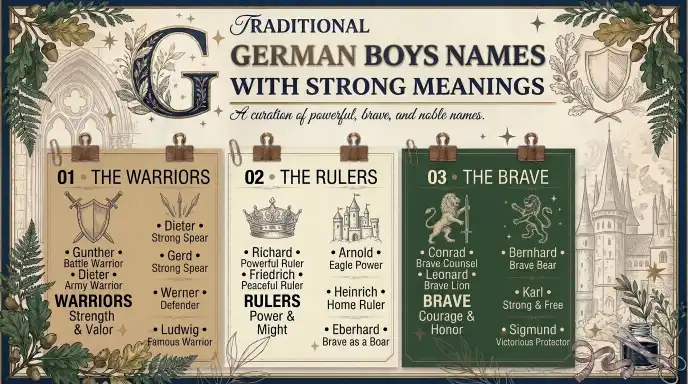
Meaning can help you find a name that feels personal. The following options have traditional interpretations or well-established linguistic associations.
| Name | Traditional Meaning or Association |
| Friedrich | Peaceful ruler |
| Heinrich | Home ruler |
| Wilhelm | Will and protection |
| Ludwig | Famous warrior |
| Konrad | Bold counsel |
| Bernhard | Brave or strong bear |
| Leonhard | Lion and strength |
| Siegfried | Victory and peace |
| Otto | Wealth or prosperity |
| Falk | Falcon |
| Arnold | Eagle and strength |
| Albrecht | Noble brightness |
Name meanings can change across languages and historical periods. Therefore, treat traditional interpretations as useful guides rather than always exact translations.
Old Fashioned German Boys Names
Old fashioned names can be a wonderful choice if you prefer a vintage sound or want to honor family heritage. Some have also returned to use in modern naming culture.
- August : A classic name with Latin roots.
- Albert : A traditional name associated with noble brightness.
- Ernst : A German name meaning “serious” or “earnest.”
- Walter : A Germanic name associated with rule and the army.
- Alfred : An old Germanic name associated with counsel and elves.
- Theodor : A form of Theodore, traditionally meaning “gift of God.”
- Franz : A traditional German form of Francis.
- Georg : A German form of George, meaning “farmer” or “earthworker” in its Greek roots.
- Karl : A traditional German form of Charles.
- Rolf : A German and Scandinavian form related to Rudolf.
- Gustav : A historic name used in Germanspeaking communities and elsewhere in Europe.
- Klaus : A traditional German short form of Nikolaus.
Vintage names can sound distinctive without being difficult to pronounce. Try saying your favorite options aloud with your family name to see which combination feels natural.
Modern German Boys Names
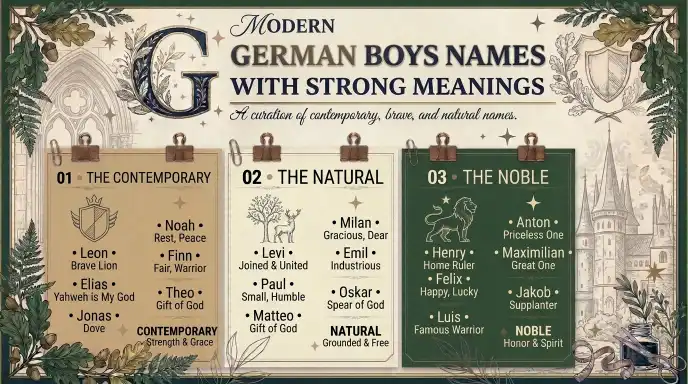
Modern feeling names are often short, easy to pronounce, and suitable for international settings. These options are used in Germany or familiar in Germanspeaking communities.
- Luca : A modern international favorite.
- Finn : Short and energetic.
- Leon : Strong, simple, and widely recognized.
- Ben : Minimal and familiar.
- Noah : A widely used international name.
- Elias : Softsounding and classic.
- Liam : An Irish origin name used in Germany.
- Jonas : A familiar name across Europe.
- Milan : A name used in several European cultures.
- Theo : A short form of Theodor or Theodore.
- Henry : An international form related to Heinrich.
- Anton : A traditional name that also feels contemporary.
A name can be modern in popularity without having a modern origin. If that distinction matters, look at both its history and its current use.
How to Choose the Best German Boy Name
Choosing a name is easier when you focus on a few practical details.
- Decide on the style. Choose between classic, modern, short, strong, or unusual names.
- Check the meaning. Make sure the traditional meaning or cultural association suits your preferences.
- Consider pronunciation. Names such as Max, Ben, and Leon are relatively straightforward for many English speakers, while Friedrich may need practice.
- Think about spelling. German letters such as ä, ö, ü, and ß can be unfamiliar outside Germanspeaking countries. Some names have alternative spellings without diacritics.
- Say the full name aloud. Check how the first name sounds with the surname.
- Research cultural roots. A name commonly used in Germany may originally come from another language.
- Check current popularity. If you want a rare name, consult recent German birthname statistics rather than relying only on a name list.
Ultimately, the best name is one that sounds right to you and has a history or meaning you appreciate.
Frequently Asked Questions About German Boys Names
Q1. What are the most popular German boys names?
Names such as Lukas, Leon, Felix, Emil, Noah, and Finn are familiar choices in Germany. However, popularity changes over time, so check the latest official or reputable German babyname rankings for the current leaders.
Q2. What are some traditional German male names?
Traditional German male names include Friedrich, Heinrich, Wilhelm, Johann, Ludwig, Konrad, Otto, and Hermann. Many have long histories and Germanic linguistic roots.
Q3. What are some strong German boys names?
Strongsounding choices include Ludwig, Friedrich, Konrad, Bernhard, Leonhard, Siegfried, and Gerhard. Several have traditional meanings associated with leadership, strength, battle, or courage.
Q4. What are some short German boys names?
Short options include Ben, Finn, Jan, Max, Tim, Tom, Paul, Lars, and Nils. Some originated outside Germany but are familiar in German speaking communities.
Q5. Which German boys names have beautiful meanings?
Consider Friedrich, traditionally interpreted as “peaceful ruler”; Konrad, associated with “bold counsel”; Otto, associated with wealth; and Leonhard, connected with the lion and strength.
Q6. What are some rare German boys names?
Distinctive choices include Anselm, Falk, Eberhard, Wendelin, Thilo, and Xaver. Rarity depends on the region and year, so verify current statistics if you want a genuinely uncommon name.
Q7. Are German boys names used in other countries?
Yes. Names such as Felix, Emil, Leon, Max, and Theo are recognizable internationally. Traditional names such as Friedrich and Heinrich may be more strongly associated with German speaking cultures.
Q8. Do all German boys names have German origins?
No. Names used in Germany may come from Greek, Latin, Hebrew, Irish, Scandinavian, and other linguistic traditions. For example, Felix has Latin roots, while Noah has Hebrew roots.
Conclusion:
German boys names offer something for every preference, from classic choices such as Friedrich and Heinrich to short, modern options like Finn, Ben, and Leon.
If you prefer a meaningful traditional name, explore names such as Konrad, Ludwig, and Wilhelm. Compare pronunciation, cultural background, and meaning before making your final choice. The right name should feel natural, memorable, and meaningful to your family.

I’m Mia Carter, a language enthusiast and writer passionate about making grammar, words, and everyday communication simple and easy to understand. I enjoy sharing clear, practical insights that help readers communicate with confidence.